
What a Rp95.9 billion loss estimate in Muara Enim reveals about pricing illegal mining inside a legal concession
By Sirkularium Editorial Team, 8 min read
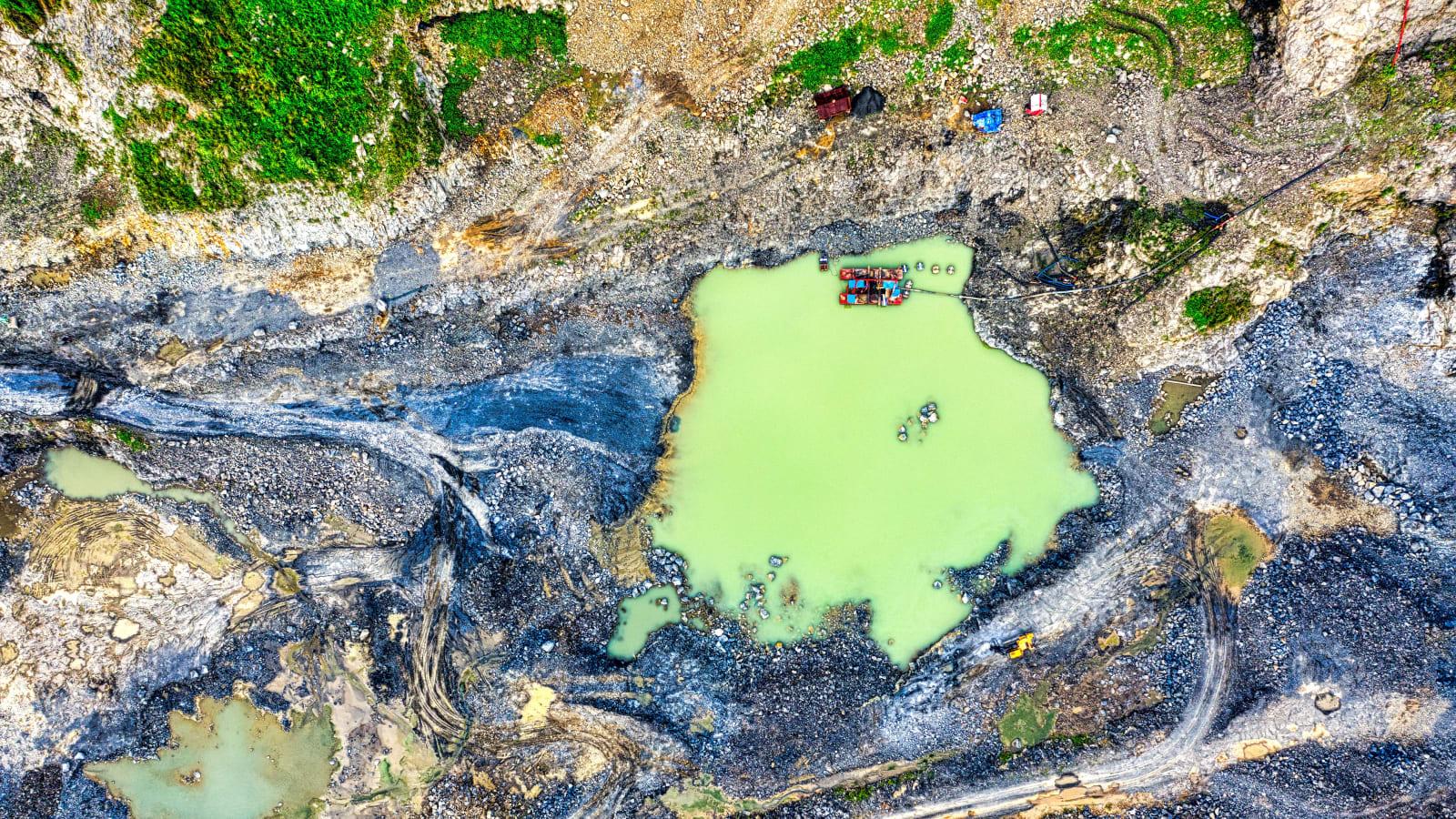
Police dismantled an illegal coal mining ring operating inside PT Bukit Asam's own permit area in Muara Enim, South Sumatra, with officials putting the state revenue loss at Rp95.9 billion. The figure is a useful fiscal snapshot, and a reminder of how much a full economic valuation would still need to add.
What happened in Penyandingan village
South Sumatra Regional Police and the Muara Enim district police ran two enforcement operations, on July 8 and July 10, 2026, against unlicensed coal mining inside the Mining Business Permit (Izin Usaha Pertambangan, IUP) area held by PT Bukit Asam Tbk (PTBA), the state controlled coal miner, in Penyandingan village, Tanjung Agung sub-district, Muara Enim regency, South Sumatra. The first raid, at a stockpile beside the Muara Enim to Baturaja highway near Kandang Ayam, netted eight suspects: five truck drivers, a stockpile foreman, a heavy equipment operator and the site's operator. A second raid two days later, in a separate pit along the Bangke river, added three more suspects.
In total, officers arrested 11 people and seized roughly 52 tons of coal, five transport trucks, four excavators, one motorcycle, eleven mobile phones and a set of travel documents. Kompol Toni Arman, deputy chief of Muara Enim Police, described a deliberate evasion pattern: coal moved at night, loads covered with tarpaulins, and the output sold below market rates to buyers who routed it toward the Jakarta, Bogor, Depok and Bekasi market. AKBP Hendri Syaputra, the Muara Enim police chief, and Kombes Pol Nandang Mu'min Wijaya, head of public relations for the South Sumatra police, both framed the case publicly as a crime against state revenue and environmental order, not a minor local trade. The 11 suspects face Article 158 of Law No. 3 of 2020 on Mineral and Coal Mining, carrying up to five years in prison and fines of up to Rp100 billion; five of the truck drivers were charged separately, under Article 161, for transporting unlicensed output.
The numbers behind the loss estimate
Taupan Ariansyah, PTBA's mining manager for the Tanjung Enim site, gave the case its headline figure.
"The total potential state revenue loss reaches Rp95.9 billion, with the estimated loss from royalties at Rp8.6 billion."
Bisnis.com, Kompas, Kontan, Monitor Indonesia and Enim TV all carried that same Rp95.9 billion figure, with Rp8.6 billion of it specifically tied to unpaid coal royalties, the non-tax state revenue that a licensed producer pays per ton sold under Indonesia's mineral and coal royalty schedule. Dunia Energi reported the case differently, putting the total loss at Rp104.5 billion and describing the Rp95.9 billion as lost general government revenue distinct from, rather than inclusive of, the Rp8.6 billion royalty shortfall. Sirkularium was not able to independently confirm which reading PTBA and the police intended. The gap between a Rp95.9 billion and a Rp104.5 billion headline for the same 11 suspects and the same 52 tons of coal is a useful illustration of how loosely "state loss" gets defined in illegal mining reporting, and why a transparent, itemized valuation methodology matters as much as the final number.
Separately, PT Bukit Asam's general manager for the Tanjung Enim site, Satria Wirawan, thanked the police for the enforcement action and said the company would continue coordinating with law enforcement and local stakeholders to keep resource management inside its concession legal and orderly.
Why the concession status changes the story
Most illegal mining cases reported in Indonesia involve operators working land with no license attached to it at all, land where no company has ever assumed reclamation or environmental obligations. This case is different in a way that matters for how the loss should be read. PTBA already holds a valid, active IUP over the ground the suspects were working. That means the land in question is subject to an approved mine plan, an AMDAL environmental permit, and a reclamation guarantee that PTBA, as the license holder, is obligated to fund and eventually draw down against actual site restoration. The illegal operators contributed nothing to any of that. They extracted coal, sold it below standard price, and left PTBA and the state to absorb both the lost royalty and whatever ground disturbance, drainage change or stockpile contamination their unregulated pits and haul routes caused inside an otherwise properly permitted concession.
That distinction is precisely what the Rp95.9 billion, or Rp104.5 billion, figure does not capture. Both numbers are royalty and revenue estimates, a fiscal calculation of what the state should have collected had the coal been sold through legal channels. Neither is an environmental economic loss figure in the sense used under Permen LH No. 7 Tahun 2014, Indonesia's standing methodology for pricing ecological damage, environmental economic loss and recovery cost. That regulation would ask a different set of questions about the same 11 suspects and the same pits: what land cover was disturbed, what condition the soil and any nearby water course were left in, and what it will cost, in verified reclamation terms, to bring the site back to the standard PTBA's own AMDAL commits it to.
What a fuller valuation would add
Indonesia already has the regulatory tools to answer those questions. GIS and remote sensing data, increasingly standard in monitoring licensed concessions, can map the exact footprint of an illegal pit against a licensed mine plan and quantify disturbed hectares with precision, rather than relying on a police headcount of trucks and excavators. Ecosystem services valuation can translate soil, water and vegetation condition around the Penyandingan and Bangke river sites into the kind of figure regulators and courts can weigh alongside the royalty loss. Reclamation guarantee accounting, already required of PTBA under its own permit, sets a monetary benchmark, roughly the standard per hectare deposit legal operators are required to post, against which illegal, unbonded extraction can be compared.
None of that appears to have been part of this week's figures, which is understandable given the case is still an active police investigation rather than a completed environmental audit. But it points to the gap between a state loss number that satisfies a criminal charge sheet and one that would satisfy a full accounting of what happened to the land, the water, and the ecosystem inside a legitimately permitted concession.
What comes next
Police have said the investigation will continue to identify other parties connected to the ring, including whoever owns or controls the specific plots being mined and whoever profited from the below-market coal once it reached Jabodetabek buyers. That points toward a broader case than the 11 suspects already in custody, and potentially toward landholders or financiers whose involvement has not yet been made public. PTBA's public posture, thanking police and pledging continued coordination, suggests the company intends to stay visibly on the side of enforcement rather than treat this as a reputational problem to manage quietly.
Sirkularium's view
For government institutions overseeing mining licenses and revenue collection, and for license holders such as PTBA, the Muara Enim case is a useful prompt rather than an isolated incident. A royalty-based loss estimate, whether the correct total is Rp95.9 billion or Rp104.5 billion, is the number that a criminal case needs. It is not the number that tells a company, a regulator, or the Ministry of Environment and Forestry what actually happened to the land. Building that fuller picture, GIS-based mapping of disturbed area, ecosystem-condition data, and a reclamation-cost benchmark tied to the same Permen LH No. 7 Tahun 2014 methodology used in ecological loss cases, is most useful when it is commissioned as an ongoing, independently verified practice inside active concessions, not assembled after the fact once police have already made arrests. That is the standard Indonesia's licensed mining sector, and the institutions that oversee it, have the most to gain from applying consistently.
Sources
- Bisnis.com, PTBA supports crackdown on illegal mining in Muara Enim, loss risk reaches Rp95.9 billion
- Kompas.com, Police uncover illegal mining in PTBA area of Muara Enim, state loss estimated
- Kontan, Illegal mining on PTBA land in Muara Enim uncovered, potential loss Rp95.9 billion
- Monitor Indonesia, South Sumatra Police dismantle illegal coal mine in PTBA area, 11 arrested
- Dunia Energi, State loses Rp104.5 billion from illegal coal mining on PTBA land in Muara Enim
- Enim TV, Muara Enim Police dismantle illegal mining in PTBA's permit area, state loses Rp95.9 billion
- Indonesian National Police (Humas Polri), South Sumatra Police save the state from potential Rp95.9 billion loss, 11 illegal miners arrested in Muara Enim