Indonesia puts the beverage industry first in line for packaging circularity
By Sirkularium Editorial Team, 8 min read
On 7 August 2026 the Ministry of Industry opened a green industry and circular economy guidance programme for the beverage sector in Jakarta, with post-consumer packaging as the entry point. Indonesia generates about 435,000 tonnes of PET bottle waste a year and already recovers 307,000 tonnes of it.
Packaging becomes an industrial policy question
The Ministry of Industry opened a guidance programme in Jakarta on Friday 7 August 2026 aimed squarely at post-consumer packaging, and it chose the beverage sector as the place to begin. The event, the Workshop on Green Industry and Circular Economy Implementation in the Beverage Industry Sector, is the first stage of a longer engagement rather than a standalone seminar. Its stated purpose is to map the sustainability practices beverage manufacturers already run, identify what is blocking wider adoption, and build a working relationship between the ministry, industry, universities, and environmental organisations.
That framing matters. For most of the past decade, packaging in Indonesia has been treated primarily as an environmental portfolio question, sitting with the Ministry of Environment and with local governments who carry the cost of collecting it. Placing it inside the Ministry of Industry's green industry agenda reframes packaging as a material input decision made on the factory floor, at the point where resin type, bottle weight, label adhesive, and recycled content are specified. Those decisions determine, years later, whether a district waste facility can sell the material or has to bury it.
Minister of Industry Agus Gumiwang Kartasasmita set out the competitiveness logic behind the programme.
The transition to a green industry is a strategic step to strengthen national industrial competitiveness as global demand for sustainable products continues to rise.
The numbers behind Indonesia's PET stream
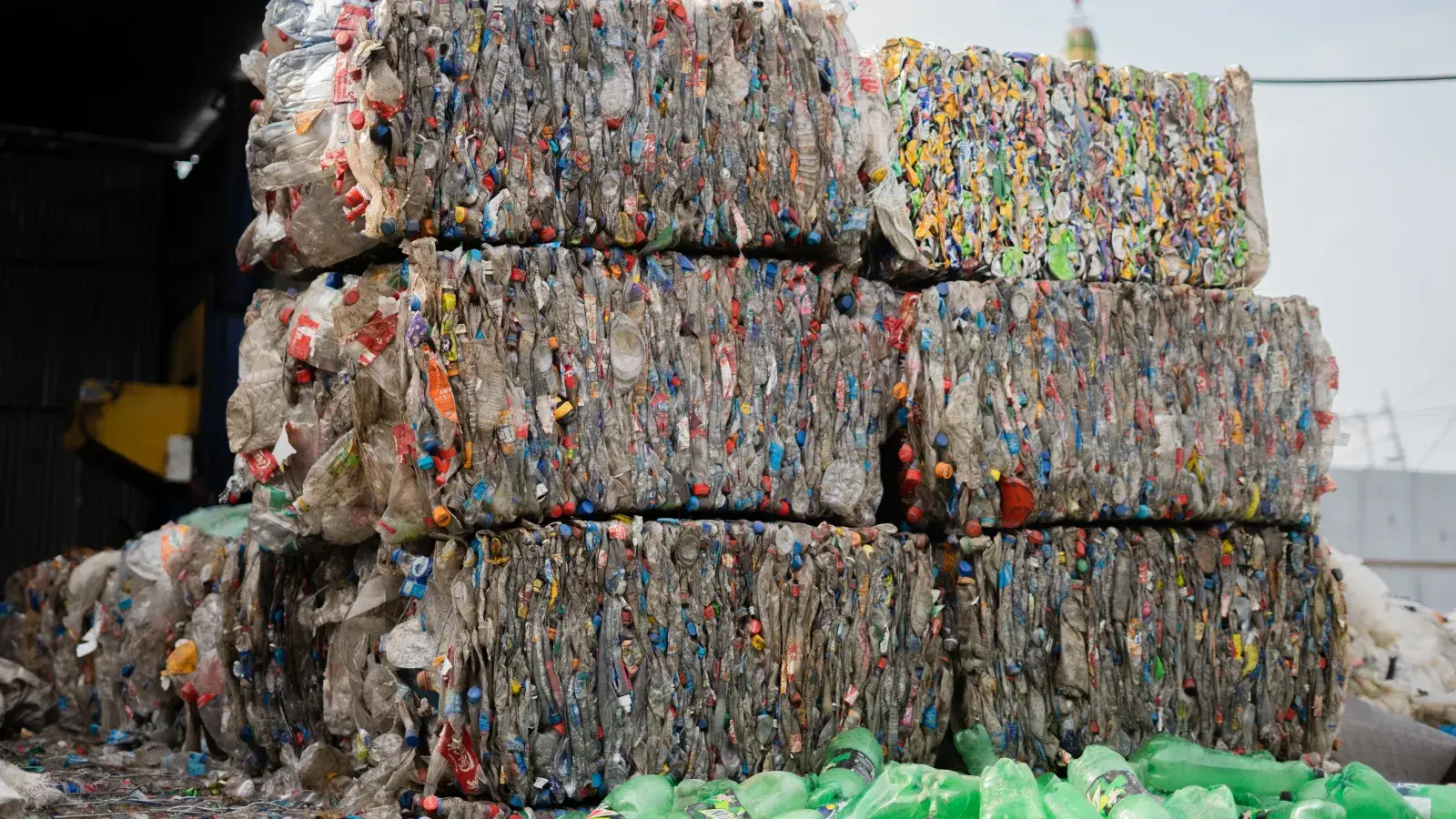
The ministry anchored the workshop in figures drawn from research by Sustainable Waste Indonesia. Indonesia generates roughly 435,000 tonnes of PET bottle waste each year. Of that, about 307,000 tonnes is collected, giving a recovery rate of approximately 71 percent. Coverage of the event varies slightly in how it labels that figure, with some outlets describing it as a collection rate and others as a recycling rate, so the precise share that is actually reprocessed into new material may sit a little below 71 percent.
Either way, the number is high by regional standards, and it is worth understanding why. PET bottles are dense, clean, easy to identify, and command a reliable price from recyclers. Indonesia's informal collection network, built around waste pickers, scrap dealers, and waste banks, has been recovering them at scale for years without needing a mandate to do it. The material moves because it is worth money.
The residual gap is therefore the interesting part. Around 128,000 tonnes of PET bottles a year still escape the recovery system, mostly the fraction that is dispersed, contaminated, or generated in places where collection economics do not work.
The wider resin picture explains why PET alone cannot carry the agenda. According to the same research, polypropylene accounts for 36 percent of national plastic consumption, low density polyethylene 17 percent, high density polyethylene 14 percent, and PET only about 9 percent. The most successfully recovered material is also the smallest slice of the stream.
Why the beverage subsector goes first
Acting Director General of Agro Industry Putu Juli Ardika described post-consumer packaging management as one concrete expression of sustainable industrial transformation. The beverage subsector was selected because it offers three levers at once: resource efficiency in production, scope to switch to renewable energy, and scope to raise the share of recycled plastic in packaging.
Merrijantij Punguan Pintaria, Director of the Beverage, Tobacco Products and Refreshment Materials Industry, made the resource argument directly. PET bottle waste is not a disposal problem to be absorbed, it is an input with established economic value, and building industrial demand around it supports emissions reduction targets in the same move.
Beverage is also a pragmatic starting point because the sector is concentrated. A relatively small number of large manufacturers account for a large share of bottles placed on the market, which makes voluntary commitments easier to negotiate and easier to verify than in a fragmented sector.
The scaffolding already exists
The programme is not being built from nothing. Law Number 3 of 2014 on Industry already provides the legal basis for green industry standards, and the ministry has been issuing sector by sector standards and certifying compliant firms under that framework for several years. The ministry has also prepared an industrial decarbonisation roadmap covering priority manufacturing subsectors, with food and beverage among them, oriented toward the national net zero emissions target of 2050 for industry.
On the supply side, the reprocessing capacity to absorb more material is largely in place. Indonesia counted roughly 241 plastic recycling firms in 2023, representing about Rp20 trillion in investment and around 2.54 million tonnes of annual processing capacity. Fiscal instruments under discussion at the Coordinating Ministry for Economic Affairs, including value added tax relief for recycled input users and procurement preference for green certified firms, are designed to pull that capacity toward higher utilisation.
What follows the workshop
The ministry has set out a sequence rather than a single event. Findings from the workshop feed into technical assistance and mentoring for a selected group of beverage manufacturers, delivered alongside expert practitioners. Those engagements then produce policy recommendations and an industry action plan, developed through a dedicated forum bringing the participating parties together.
This is a deliberately slow structure, and that is a reasonable design choice. Packaging redesign runs on capital expenditure cycles measured in years, not quarters. A mandate issued ahead of an evidence base tends to produce compliance paperwork rather than material change. Mapping first, assisting second, and legislating third gives the resulting rules a better chance of being implementable.
Sirkularium's view
For government and public institutions, this initiative is best read as the upstream half of a system whose downstream half is already under construction. Indonesia is in the middle of an unusually active period on solid waste: open dumping is being phased out at landfills nationally, refuse derived fuel and waste to energy capacity is being procured at scale, and source separation obligations are tightening in the largest cities. All of that work handles material after it has been produced. The Ministry of Industry's programme works on the decision that created the material in the first place.
Three implications follow for public institutions. First, packaging design standards agreed with industry are a direct input to municipal facility planning. A district investing in a sorting line needs to know whether the bottles arriving in five years will be mono material and easy to bale, or multilayer and destined for residue. Second, the 128,000 tonne PET recovery gap is a geographic question as much as a technical one, concentrated where collection distances are long and buyer networks are thin, which is precisely where public collection infrastructure has the most leverage. Third, the fiscal instruments under discussion will only translate into demand for locally collected material if quality is consistent, which puts weight on the source separation programmes local governments are already running.
The most valuable contribution local government can make to industrial circularity is not more collection tonnage, but cleaner, better sorted, more predictable tonnage.
What to watch next is the composition of the mentoring cohort and the timeline attached to the industry action plan. If the plan carries recycled content targets with dates, it becomes a planning signal that waste managers, recyclers, and financiers can all build against. If it stops at general principles, the recovery rate for the resins outside PET is unlikely to move much. Sirkularium will track the forum's output and how it connects to the extended producer responsibility obligations already in force.
Share of national plastic consumption by resin type
Values in percent
Sources
- ANTARA News, Ministry of Industry strengthens packaging management to drive green industry
- ANTARA News English, Indonesia steps up packaging recycling to advance green industry
- ANTARA News Kalimantan Selatan, English wire copy with technical assistance and action plan detail
- Vibizmedia, 435 thousand tonnes of PET waste a year as the beverage industry targets a greener future
- TubasMedia, Ministry of Industry accelerates green industrial transformation through circular economy implementation
- RRI, Ministry of Industry accelerates green industry and drives the national circular economy
- ANTARA News English, Indonesia devising policy to develop sustainable plastic industries (background on recycling capacity)