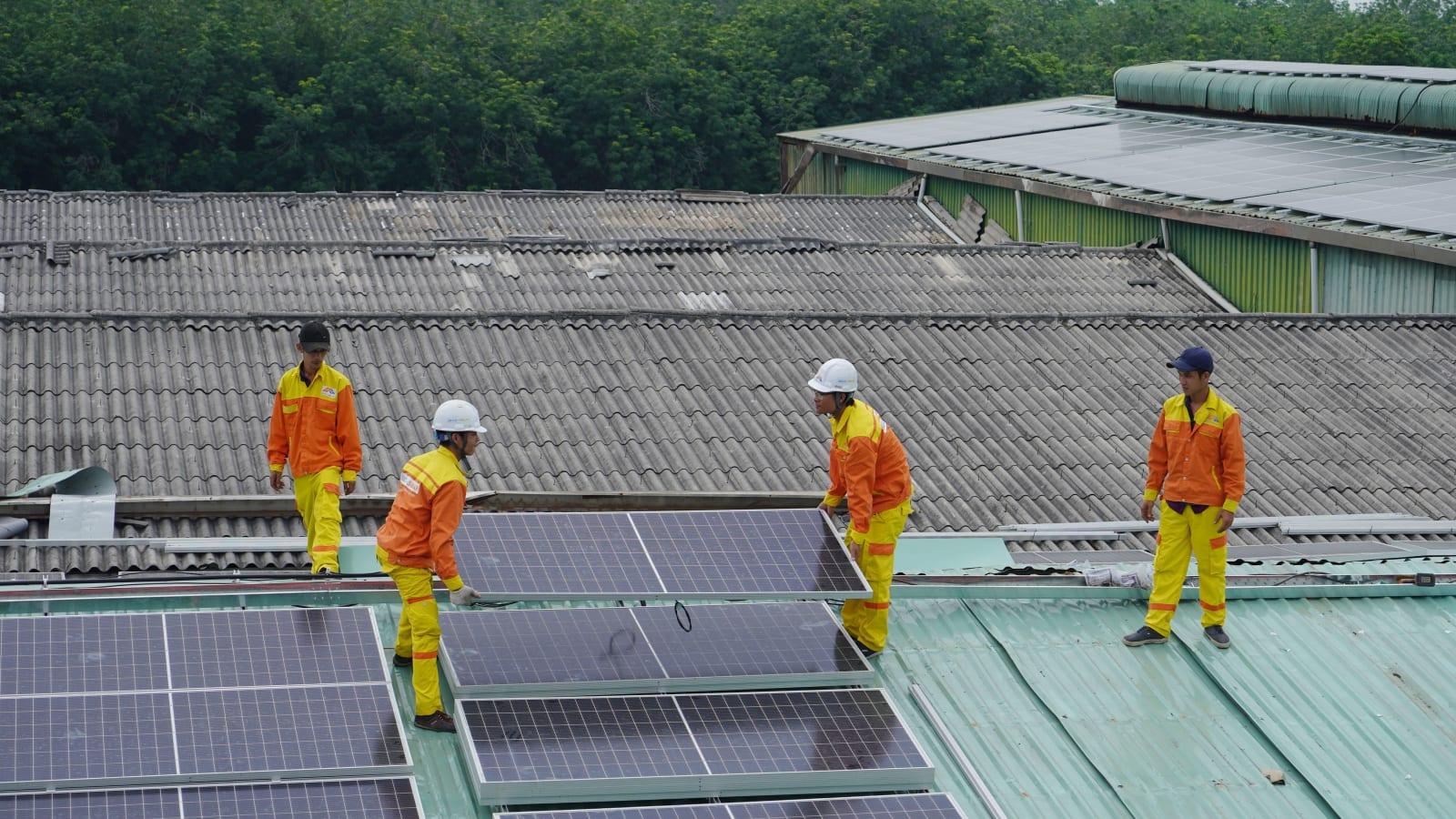
Rooftop solar across 11 factories wins Danone Indonesia a national decarbonization award
By Sirkularium Editorial Team, 8 min read

Danone Indonesia's 10.4 megawatt-peak rooftop solar fleet across 11 production sites took the industry category at the Indonesia Solar Summit 2026, a case study for a national rooftop solar segment that has more than doubled in a year.
What happened
Danone Indonesia received the Solar Awards 2026 in the industry category at the Indonesia Solar Summit (ISS) 2026, held in Bali from July 14 to 16 and organized by the Institute for Essential Services Reform (IESR) together with the Coordinating Ministry for Economic Affairs, the Bali provincial government, and the National Energy Council (DEN). The recognition, announced in detail this week, covers a rooftop solar fleet the company has built up across 11 production facilities: Klaten, Ciherang, Banyuwangi, Mekarsari, Mambal, Cianjur, Langkat, Prambanan, Yogyakarta, Sentul, and Ciracas in East Jakarta. Combined installed capacity across those sites now exceeds 10.4 megawatt-peak (MWp).
IESR framed the award as recognition for demonstrated, sustained implementation rather than a one-off installation. "Solar Awards merupakan bentuk apresiasi kepada institusi yang telah menunjukkan implementasi nyata dalam pemanfaatan energi surya," said Fabby Tumiwa, IESR's chief executive, describing the awards as appreciation for institutions that have shown real, working implementation of solar energy, not just stated ambition. West Java Province took the local government category and Gadjah Mada University the university category, alongside Danone's industry award, giving the summit's honors a deliberate spread across public, academic, and private-sector actors.
Karyanto Wibowo, Danone Indonesia's Director of Public Affairs and Sustainability, positioned the rooftop fleet as one piece of a broader operational sustainability program that also includes reforestation, biodiversity conservation, and transport efficiency work. The company reports having planted more than 2.6 million trees across roughly 6,000 hectares and developed 20 biodiversity parks alongside its energy program, indicating that the solar build-out sits inside a longer-running corporate environmental strategy rather than a standalone project timed to the summit.
The numbers behind it
Danone's 10.4 MWp rooftop fleet is a small but illustrative slice of a national rooftop solar segment that has been growing quickly. Ministry of Energy and Mineral Resources data cited at the summit put installed rooftop solar (PLTS Atap) capacity at 406.78 megawatts across roughly 10,437 customers in March 2025, rising to 538 megawatts and 10,882 customers by June 2025. By April 2026, the ministry's figures show rooftop solar contributing 895 megawatts to a national solar capacity of about 1.5 gigawatts overall, more than doubling the segment's size in roughly thirteen months.
That growth is happening against a solar resource base the government itself describes as barely tapped. Indonesia's total solar potential is estimated at approximately 3,294 gigawatt-peak, against which even the 1.5 gigawatts currently installed nationally represents a small fraction. The government's stated ambition is to reach 100 gigawatts of solar PV capacity, split across rooftop, utility-scale ground-mounted, and floating solar programs, positioning rooftop installations like Danone's as one lever among several rather than the primary route to the target.
Industrial facilities are, notably, the dominant category of rooftop adopter today. Sector breakdowns discussed around the summit show industrial rooftop solar accounting for the large majority of installed rooftop capacity nationally, ahead of commercial and residential segments, a pattern consistent with the economics of solar payback for facilities that run high, steady daytime power loads, exactly the profile of Danone's beverage and dairy production lines.
"Melalui penghargaan ini, kami berharap semakin banyak praktik baik yang dapat mendorong perkembangan ekosistem energi surya sekaligus memperkuat transisi menuju ekonomi rendah karbon di Indonesia," Tumiwa said, expressing hope that the award encourages more good practices that develop the solar ecosystem while strengthening Indonesia's transition to a low-carbon economy.
Why it matters
For Indonesia's industrial decarbonization agenda, the significance of the Danone case is less about the 10.4 MWp figure itself and more about what it demonstrates repeatably: rooftop solar deployed across dispersed manufacturing sites, rather than concentrated in a single flagship plant, can be assembled facility by facility as a standard operating practice. That distinguishes it from headline-grabbing single-site megaprojects and offers a template closer to what most of Indonesia's manufacturing base, spread across small and mid-sized industrial estates, can realistically replicate.
It also reinforces a point regulators have been making about where near-term rooftop solar growth will come from. With industrial users already the largest rooftop segment, policy tools aimed at simplifying net-metering rules, interconnection approval timelines, and financing for corporate solar power purchase agreements stand to have outsized effect precisely because industry has already shown it will adopt the technology once the economics and permitting line up.
The awards structure itself, spanning a provincial government, a public university, and a private manufacturer, signals that IESR and its government co-organizers are treating solar adoption as a whole-of-society undertaking rather than a purely commercial one. That framing matters for an audience of public institutions: it positions government procurement, campus rooftop programs, and corporate manufacturing investment as complementary tracks toward the same 100-gigawatt target, rather than competing claims on the same limited pool of incentives.
What comes next
The near-term test is whether the growth rate recorded between March 2025 and April 2026, roughly a doubling of national rooftop capacity, can be sustained as the segment moves past its earliest and most economically obvious adopters. Ministry quota allocations under the 2025-2034 electricity supply business plan (RUPTL) call for rooftop solar capacity to keep climbing year over year through the rest of the decade, and industrial uptake at the pace Danone and peer manufacturers have shown will be a key input to whether those quotas are met or exceeded.
Watch also for how IESR and the ministry choose to publicize next year's Solar Awards cohort. A widening list of repeat industrial applicants, rather than a static handful of early movers, would be the clearer signal that rooftop solar has moved from a sustainability differentiator to a default line item in industrial facility planning.
Sirkularium's view
For government and public institutions supporting Indonesia's energy transition, the Danone case offers a concrete, bounded example of what industrial energy efficiency and decarbonization can look like at facility scale, distinct from the large centralized generation projects that dominate national energy transition headlines. Eleven separate installations across eleven separate locations is, in effect, eleven separate permitting, financing, and engineering exercises completed successfully, evidence that the regulatory and commercial pathway for corporate rooftop solar is workable today, not contingent on future policy reform.
Institutions shaping industrial decarbonization roadmaps, net-metering regulation, or green financing programs should treat the doubling of national rooftop capacity over the past year as a signal to remove remaining friction, particularly around interconnection timelines and financing structures for mid-sized manufacturers who may lack the balance sheet of a multinational like Danone. Recognition programs such as the Solar Awards are useful, but the more durable policy lever is ensuring that the permitting and financing pathway already proven by early industrial adopters is made routine and accessible for the much larger population of smaller manufacturers that make up the bulk of Indonesia's industrial base.
Indonesia's rooftop solar (PLTS Atap) installed capacity
Values in MW
Sources
- Sindonews (ekbis.sindonews.com), economics and business desk
- Antara News, IESR on industrial rooftop solar strengthening the national solar ecosystem
- Disway, Danone Indonesia solar award coverage
- Tribunnews, industrial decarbonization and the 11-factory rooftop solar rollout
- Media Indonesia, industrial solar adoption and decarbonization
- NREE UNAIR, rooftop solar development in Indonesia, progress and challenges