IMIP scales up solar across the Morowali nickel park, from canal tops to a 200 MWp plant
By Sirkularium Editorial Team, 8 min read
Tenants at the Indonesia Morowali Industrial Park now run about 11 MWp of solar, with a 66 MWp rooftop system and a 200 MWp plant in development. The rollout gives Indonesia's largest nickel processing hub a practical first step on the low-carbon electricity pillar of the national nickel decarbonisation roadmap.
The Indonesia Morowali Industrial Park (IMIP) in Central Sulawesi has set out how solar power is spreading across its tenants. It is the country's largest integrated nickel processing complex. The update, reported on 28 and 29 September 2026 by ANTARA, detikFinance, Industry.co.id and several regional outlets, lists four companies already generating their own solar power, one close to finishing, and two much larger projects under development.
The numbers are modest against the park's total energy use, and the company does not claim otherwise. Still, the direction is clear. What started as small arrays over water canals is growing into rooftop systems measured in tens of megawatts and a dedicated solar plant of 200 MWp. For a sector whose emissions depend so heavily on how its electricity is made, that shift matters.
What IMIP reported
The operating systems are spread across four tenants. PT BTR runs the largest at 9.5 MWp. PT Indonesia Tsingshan Stainless Steel (ITSS) has 0.957 MWp, PT Indonesia Guang Ching Nickel and Stainless Steel Industry (GCNS) has 0.304 MWp, and PT Ocean Sky Metal Industry (OSMI) has 0.188 MWp. Together that is roughly 10.95 MWp already in service.
A further 0.57 MWp at PT PMMI is close to completion. PT QMB is mapping where solar can replace part of its fossil fuel use.
The two large projects set the scale of what comes next. PT Dexin Steel Indonesia (DSI) is installing a 66 MWp rooftop system of around 119,800 panels across 396,700 square metres of industrial roof. PT Sumber Energi Surya Morowali (Sesmo) is developing a 200 MWp plant that needs roughly 200 hectares of land.
Yulius Susanto, Deputy Operational Director of PT IMIP, framed the programme as part of a wider commitment.
"We are committed to moving toward green industry. One part of that is reducing the use of fossil fuels." Yulius Susanto, Deputy Operational Director, PT IMIP
He tied the effort to cutting emissions from company operations and to the government's energy transition programme and its Net Zero Emission target for 2060.
One park, two ways of placing panels
A notable feature of the update is that IMIP is not applying one design everywhere. It matches the technology to the site.
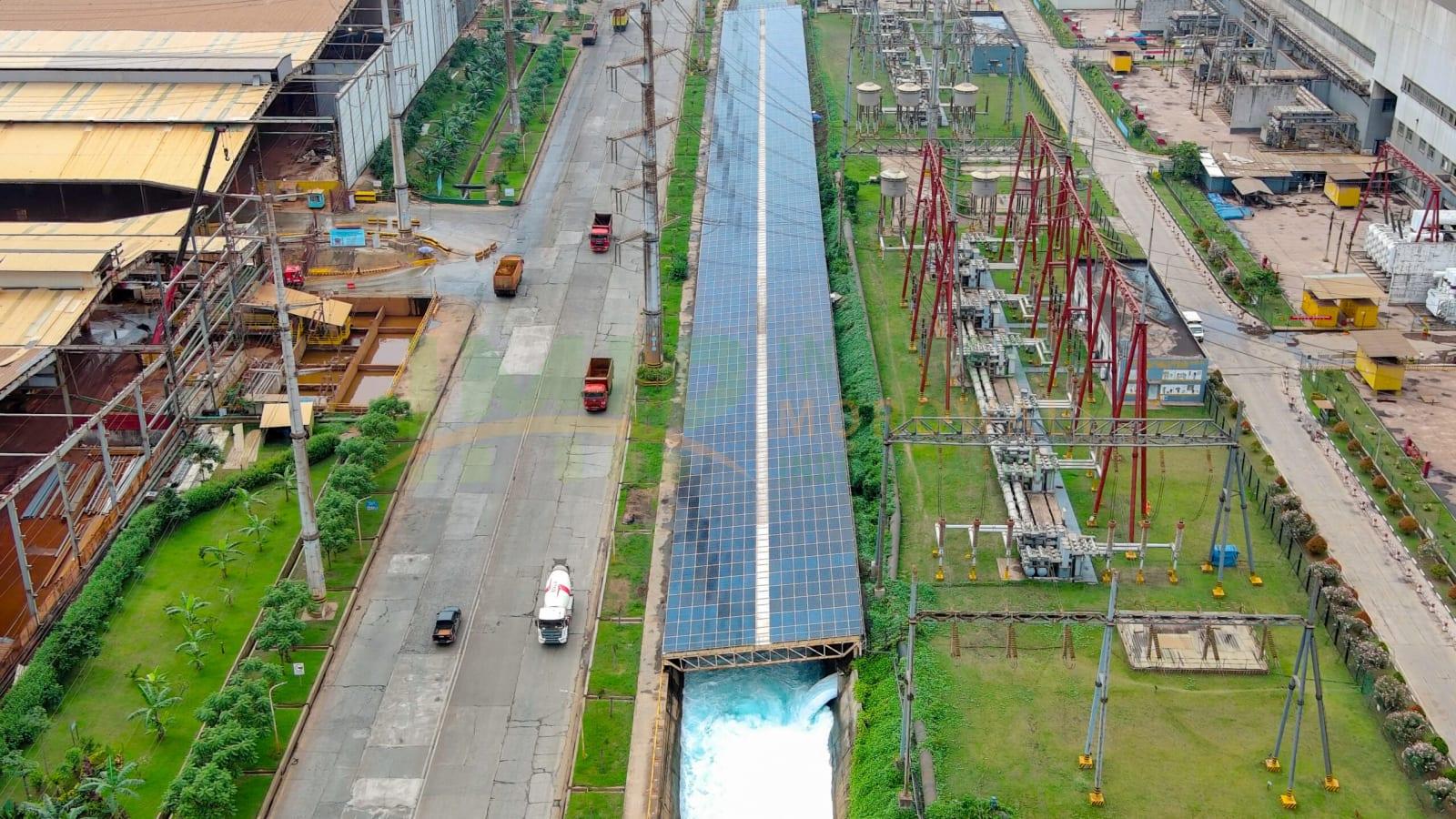
GCNS and ITSS use canal top solar, with panels mounted over the water channels that run through the estate. This puts otherwise unused space to work and needs no new land. OSMI, BTR, PMMI, QMB and DSI mount panels on the roofs of their industrial buildings. Smelters and steel plants have very large, flat roof areas, so rooftop solar can reach real scale without competing for ground space. The DSI system, at almost 40 hectares of roof, shows how far that can go.
The Sesmo plant is a different model again: a ground-mounted plant on dedicated land. Earlier reporting by Radar Palu in May 2026 described the Sesmo project as 200 MWp with 80 MW of battery storage on about 224 hectares, supplying Sesmo's own operations first, with surplus power potentially available to the wider IMIP grid. The September update gives the land need as roughly 200 hectares. The figures for Dexin also differ slightly between reports, 66 MWp in September against 65.89 MWp in May. Sirkularium notes both and treats the latest figures as the working numbers.
If every project listed reaches operation, installed solar at IMIP would rise from about 11 MWp to around 277 MWp. That is roughly a 25-fold increase.
Why solar at a nickel park matters
Indonesia supplies around 60 percent of the world's nickel, and Morowali is one of the centres of that output. How this nickel is processed now affects Indonesia's climate targets and the country's position in global battery and stainless steel supply chains.
In June 2025, the Ministry of National Development Planning (Bappenas) and WRI Indonesia launched a National Nickel Industry Decarbonisation Roadmap. It was prepared with more than 30 mining and smelting companies from Sulawesi and North Maluku, 15 government agencies and academic partners. It targets an 81 percent cut in nickel industry emissions by 2045. Without action, emissions could instead rise by 86 percent over the same period. Leonardo A. A. T. Sambodo, a deputy at Bappenas, described the target as aligned with Indonesia's net zero commitment before 2060.
The roadmap rests on four strategies: energy and material efficiency, fuel switching, material substitution, and low-carbon electricity. It gives low-carbon electricity priority, because power supply is the largest source of emissions in nickel processing. According to the roadmap discussion reported by Media Nikel Indonesia, Indonesian nickel currently carries an emissions intensity around 7 to 10 times higher per tonne of metal than international benchmarks, driven largely by coal-based power. The roadmap estimates a need for 47.3 GW of new renewable capacity by 2045, including 5.1 GW of hydrogen-based generation in North Maluku.
Seen against that frame, IMIP's solar programme is an early, concrete move on the roadmap's priority pillar. Rooftop and canal top systems are also close cousins of energy efficiency. They cut purchased fuel and power at the point of use, on assets that already exist.
Export markets increasingly ask how a tonne of nickel was made, not only where. On-site renewable power is one of the few levers a smelter can pull without redesigning its core process.
There is also a commercial logic. Buyers in the battery and automotive supply chain are paying closer attention to the carbon footprint of the metals they source. Every megawatt-hour of solar a tenant produces lowers the footprint of its product and can be documented. That record will matter more as supply chain disclosure rules tighten in major markets.
What to watch next
Three things will show how quickly this programme turns into lower emissions.
First, delivery of the two large projects. Dexin's 66 MWp rooftop and Sesmo's 200 MWp plant make up more than 95 percent of the pipeline. Their commissioning dates, and whether Sesmo's battery storage is built as described, will decide whether the park's solar share becomes meaningful at the scale of its operations.
Second, how surplus solar is shared. Radar Palu's account suggests Sesmo's output could feed the wider IMIP network. A clear internal arrangement for moving solar power between tenants would let the park use its best sites fully, rather than limiting each system to one building's load.
Third, how the effort is measured. The update gives capacity in MWp but not generation or avoided emissions. Publishing annual output in MWh and tonnes of CO2 avoided would let IMIP track progress against the 81 percent roadmap target and give buyers verifiable data.
Sirkularium's view
For government and public institutions, IMIP's rollout is a useful example of industrial decarbonisation starting where it is most practical: on roofs, over canals and on land the estate already controls. It needs no new transmission and no change to smelting technology, and it can begin while longer-term options such as hydrogen and grid interconnection are still being planned.
Sirkularium sees three steps that would help turn examples like this into a pattern across Indonesia's industrial estates. The first is to recognise on-site solar and storage at smelters in the implementation of the nickel decarbonisation roadmap, with simple reporting templates for generation and avoided emissions. The second is to connect industrial estate solar with the energy management obligations that already apply to large energy users, so rooftop and canal top systems count toward those plans. The third is to build financing that matches these assets: green loans and sustainability-linked facilities sized for 10 to 70 MWp industrial rooftops, which fall between small commercial projects and utility-scale plants.
IMIP's 11 MWp in operation is a start, and its 277 MWp pipeline is a statement of intent. If the large projects are delivered and results are reported openly, Morowali could offer a practical model for the other processing hubs that will decide how fast Indonesia's nickel industry decarbonises.
Solar capacity by IMIP tenant, operating and in development
Values in MWp
Sources
- ANTARA, IMIP keeps developing solar across the industrial estate
- ANTARA, IMIP accelerates solar construction in support of NZE 2060
- detikFinance, IMIP keeps developing solar to support the energy transition
- Industry.co.id, Morowali industrial park speeds up solar projects
- Teraskabar, IMIP expands solar operations for green industry
- Kaidah.ID, IMIP speeds up solar development toward green industry
- Radar Palu (Jawa Pos), PT Sesmo builds a 200 MWp solar plant in Morowali
- ANTARA, Indonesia commits to cutting nickel industry emissions 81 percent by 2045
- Media Nikel Indonesia, Bappenas and WRI Indonesia on nickel industry decarbonisation