Jakarta to prioritise Bogor for a grant of used compactor trucks and fire engines, as the agglomeration shares its fleet
By Sirkularium Editorial Team, 8 min read
On 29 September 2026 Governor Pramono Anung said the Jakarta provincial government will give priority to Bogor City's request for serviceable used garbage compactor trucks and fire engines, and offered ambulances and school buses as well. The request, first lodged in the summer, now moves to a formal written submission.
A request made at a transport day, answered in public
On Tuesday 29 September 2026 the Jakarta provincial government marked National Transportation Day with a provincial ceremony in Kelapa Gading, North Jakarta. Among those present were the Mayor of Bogor, Dedie A. Rachim, and his deputy, Jenal Mutaqin. The occasion gave the two governments a chance to settle a matter that had been open since the summer.
Governor Pramono Anung Wibowo confirmed that Jakarta will give priority to Bogor City's request for vehicle grants. The request covers used but serviceable garbage compactor trucks and fire engines. The governor went further than the original ask, offering ambulances and school buses as well if Bogor needs them.
"We will prioritise Bogor. Including ambulances if they still want them. Including school buses." Pramono Anung Wibowo, Governor of Jakarta
The governor's one condition was procedural. He asked Bogor to put the request in writing so that the provincial administration can process it formally, and he instructed Bogor officials to complete the documentation to speed the grant along.
How the request came about
Bogor first lodged the request earlier in the year. When it became public in August 2026, Deputy Mayor Jenal Mutaqin said it had been submitted about three weeks before, and Mayor Dedie described it as a natural step between two neighbouring governments in a single agglomeration. Bogor sits upstream of Jakarta, both geographically and in the daily flows of commuters, water and goods that bind the metropolitan region together.
The city did not name a number of vehicles. The mayor said the quantity would depend on what Jakarta is able to release, and that the request is for used units in serviceable condition rather than new ones. He was open about the reason. Jakarta has a much larger budget, and buying new heavy vehicles is not within Bogor's current fiscal room. A grant of well maintained second-hand units allows the city to strengthen services now while its own procurement plans run their course.
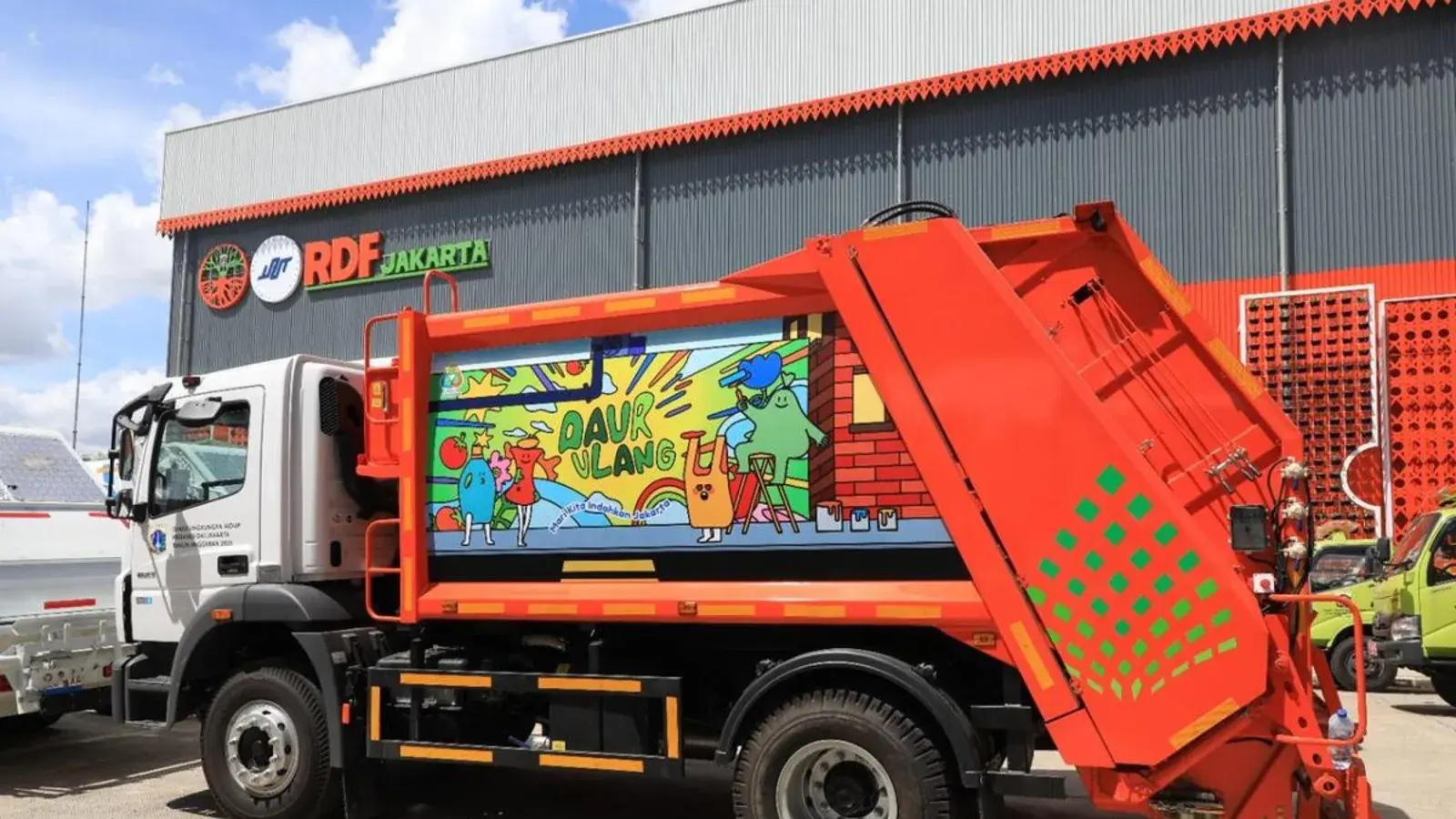
On the fire side, Jawa Pos reported that the priority is ladder-equipped engines, reflecting the growth of high-rise buildings and industrial premises in the city. On the waste side, the need is for compactor trucks, the enclosed units with a hydraulic rear compaction mechanism that carry more waste per trip and keep it contained on the road.
A fleet under renewal
Bogor's waste collection runs on two main vehicle types, dump trucks and container trucks, and the fleet has been under a programme of staged repair. In mid-2024 the city government reported that 20 to 30 vehicles needed repair and that funding for new vehicles was being prepared, alongside requests for central government support. Deputy Mayor Jenal Mutaqin noted this year that several trucks had damage to their rear sections, and that units in poor condition are being taken out of service while repairs proceed.
The Bogor environment agency has been applying that rule in practice. When a damaged container drew public attention in September, the agency head, Rudy Mashudi, confirmed that it had been withdrawn for repair on the Saturday and that the truck had continued work with an alternative container. The episode shows a city that is actively managing its fleet, retiring what cannot be used safely and keeping the service running with what can.
The fleet also demonstrated its resilience this month. After the fire at TPAS Galuga in early September, 128 Bogor city trucks resumed disposal at the site on 9 September on a rotating schedule, only one day after the closure. Additional compactor units from Jakarta would add capacity and flexibility to that operation, and would reduce the strain on older vehicles while replacements are procured.
The choice of compactor trucks is significant in its own right. Open dump trucks and older container units carry loose waste, which limits the load per trip and leaves the cargo exposed to rain. Enclosed compactor bodies press the load, so each vehicle carries more and makes fewer journeys to the disposal site, which saves fuel and crew time. They also hold leachate inside the body rather than letting it reach the road, which matters for public health and for how residents perceive the service. For a city whose trucks travel a long route out to Galuga in the Bogor regency, fewer and cleaner trips per tonne are a direct operational gain.
Why this matters for the circular economy
Vehicle grants between governments are not usually discussed as circular economy policy, but in practice they are a clear example of it. A compactor truck that has reached the end of its planned service life in one of Indonesia's best funded municipal fleets may still have years of useful work left in a smaller city. Transferring it keeps a valuable asset in productive use, postpones the emissions and material demand of manufacturing a replacement, and saves public money on both sides. Jakarta avoids the cost and effort of disposing of the vehicle. Bogor gains capacity at a fraction of the price of new equipment.
The transfer also fits the direction of regional cooperation. Jakarta's governance framework as a special region now places strong emphasis on the agglomeration with its neighbouring cities and regencies, and waste is one of the services where that cooperation has the most practical value. Waste in Greater Jakarta does not respect administrative boundaries. Rivers carry it downstream, and landfill capacity in one jurisdiction affects the options of another.
For Bogor, better collection is also a precondition for the investments already under way. Upstream, the city opened a waste station at City Hall on 26 September where residents can exchange sorted inorganic waste for digital rewards. Downstream, the Bogor Raya waste-to-energy facility at Galuga broke ground in mid September. Between those two points sits the collection fleet. A city that the municipal government in 2024 put at around 700 tonnes of waste a day, diverting about 18 percent of it through 32 TPS3R units and 300 waste banks, needs reliable trucks to move what remains, and in the future to move sorted streams separately.
Sirkularium's view
Jakarta's decision to prioritise Bogor is a small administrative step with a useful principle behind it: public assets should be used for their full working life, and the agglomeration should share capacity where one member has more than it needs and another has less.
Sirkularium sees three ways to make the most of it. First, the grant should be matched to Bogor's service design. Compactor trucks suited to the city's narrow residential streets, and units that can be configured to carry sorted organic and inorganic streams separately, will deliver more value than a simple count of vehicles. Second, a technical inspection and a short maintenance plan for each transferred unit, agreed between the two environment agencies, would give both sides confidence that the vehicles will serve safely for a defined period. Third, the arrangement could become a standing mechanism rather than a one-off. A simple agglomeration register of municipal vehicles approaching replacement, open to neighbouring governments, would let Depok, Tangerang, Bekasi and the Bogor regency plan around the same opportunity.
For national policymakers, the case is a reminder that fleet capacity is an often overlooked constraint in local waste performance. The national target of managing all waste by 2029 depends not only on processing plants and sorting at source, but also on the trucks that connect them. Guidance on transferring serviceable vehicles between regions, including how to record the assets and meet safety standards, would make such cooperation easier to repeat.
What to watch next is Bogor's written submission and the number and type of units Jakarta releases. A handover before the rainy season, when collection pressure and flood risk both rise, would put the new capacity to work when it is most needed.
Sources
- ANTARA News, the Jakarta provincial government prioritising a grant of fire engines and garbage trucks to Bogor
- Jawa Pos, Pramono approving Bogor's grant request including ladder fire engines
- Kompas Megapolitan, Bogor City submitting its request for used garbage trucks and fire engines in August
- Detik, the Bogor environment agency withdrawing a damaged waste container for repair
- Bogor City Government, staged repair of the waste fleet and the longer-term plan
- ANTARA News, 128 Bogor city waste trucks returning to TPAS Galuga in September