Solar and storage move to the front of Indonesia's grid plans
By Sirkularium Editorial Team, 9 min read
.webp&w=3840&q=75)
Hybrid solar-plus-storage projects are moving from pilot schemes to national policy, with PLN's ten-year grid plan and a 100 GW village solar program both betting on batteries to make renewables dependable.
From skepticism to a hotspot
Indonesia is increasingly described, alongside Vietnam and the Philippines, as a renewable investment hotspot rather than only an emissions-heavy power system built around coal. Much of that shift runs through hybrid projects that pair solar with battery storage, a combination that answers the intermittency which once held solar back and kept grid planners cautious. Solar without storage delivers power only when the sun cooperates. Adding batteries lets that power be shifted into the evening peak and used to steady the grid, which is what makes solar dependable enough to plan a national system around.
The country entered 2026 with roughly 1.49 GW of cumulative installed solar capacity after adding 546 MW in 2025, a small base by the standard of the targets now on the table. What has changed is not the installed number but the seriousness of the plans stacked behind it, from PLN's own ten-year grid blueprint to a village-level solar and storage program mandated directly by the president.
What the national plan actually calls for
PLN's Electricity Supply Business Plan, known as the RUPTL, for 2025 to 2034 sets out 69.5 GW of new generation capacity, of which 42.6 GW, or 76 percent, is meant to come from renewable sources. Solar PV carries the largest share of that renewable build at 17.1 GW, ahead of hydropower at 11.7 GW, wind at 7.2 GW, geothermal at 5.2 GW, and bioenergy at 0.9 GW, the breakdown shown in the chart above. Storage sits alongside the generation targets rather than inside them: the plan calls for 10.3 GW of energy storage capacity, split between 6.0 GW of pumped hydro and 4.3 GW of battery energy storage systems, intended to let the grid absorb that much intermittent solar and wind without losing reliability. Officials expect renewables to reach 35 percent of the overall electricity mix by 2034 under this plan.
Running in parallel, and mandated directly by President Prabowo Subianto, is a distinct and far larger ambition: a 100 GW Solar Power Plant Plan for Village Cooperatives. Of that total, 80 GW would be distributed in small 1 MW solar arrays paired with 4 MWh of battery storage apiece, adding up to 320 GWh of battery capacity across as many as 80,000 villages, with the remaining 20 GW built as larger centralized plants connected to or independent of the main grid. Each village system would be owned and operated by a village cooperative under the Merah Putih program, rather than by PLN directly. An initial target of 10,000 systems installed was set for August 2025.
Why the economics finally work
Fabby Tumiwa, CEO of the Institute for Essential Services Reform, has modeled the village program's costs against the diesel generation it would replace in isolated grids.
"The estimated levelized cost of electricity for this system is about $0.12 to $0.15 per kilowatt-hour over the next 25 years, compared to $0.20 to $0.40 per kilowatt-hour for a diesel generator," said Fabby Tumiwa, CEO of the Institute for Essential Services Reform.
That gap, roughly half the cost of diesel at the upper end, is the economic case in one number, and it explains why a program this large is being attempted at all in villages where fuel logistics have long made electricity expensive. Tumiwa was equally direct, however, that building 100 GW of distributed solar within five years would be very challenging, a caution worth holding alongside the cost advantage.
Utility-scale hybrids are moving too
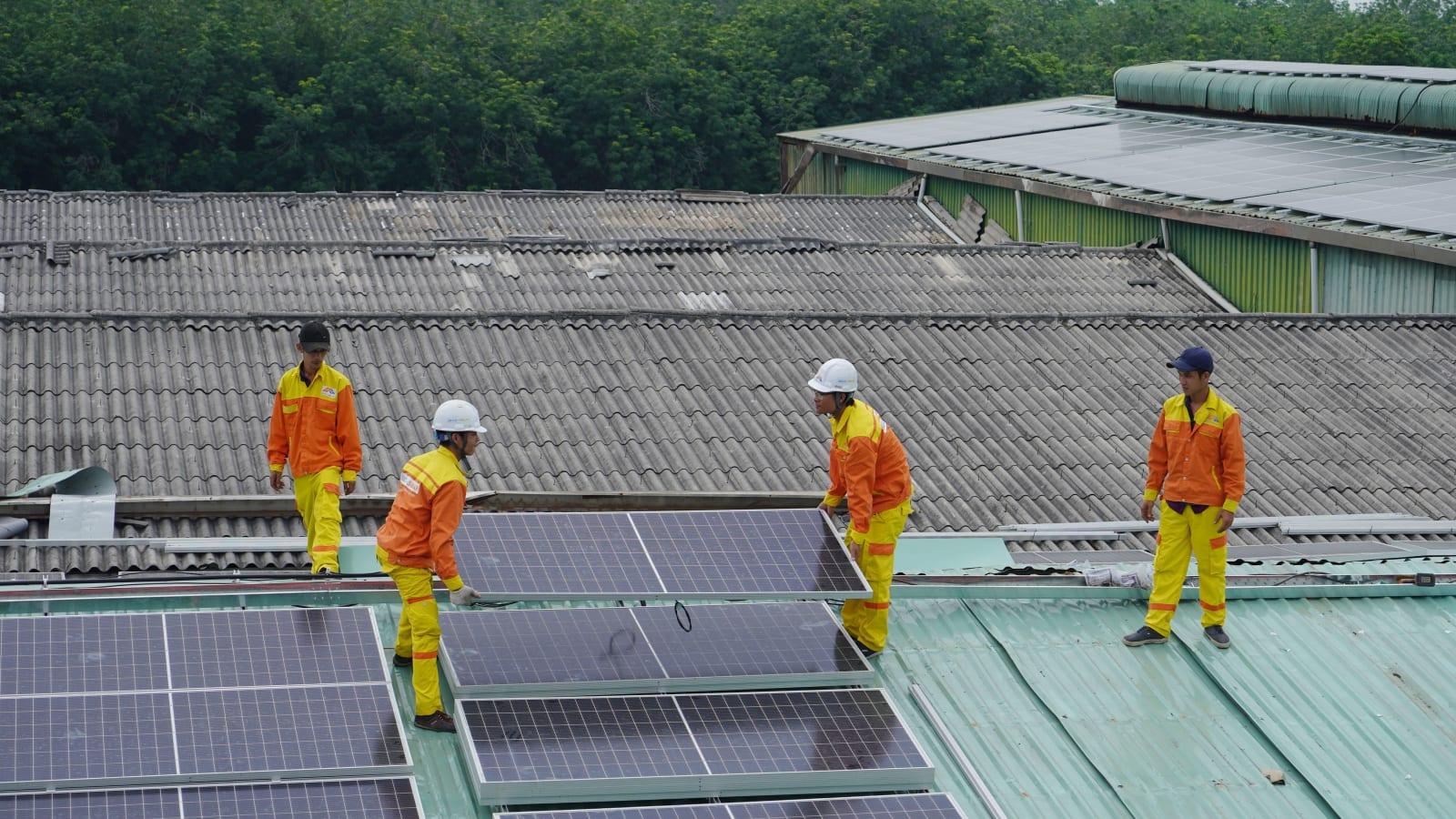
Village micro-grids are not the only proof point. In Nusantara, Borneo, PT Sembcorp Renewables Indonesia and the state-owned PT PLN Nusantara Renewables have built a 50 MW solar array paired with a 14.2 MWh battery system across 87 hectares, using 114,420 bifacial solar modules and 126 lithium iron phosphate battery packs, expected to generate about 93 GWh of renewable energy a year. It was Sembcorp's first large-scale solar venture in the Indonesian market.
"Sembcorp is pleased to partner with PLN in this project. Leveraging our experience, we will deploy advanced energy storage to pair with the latest solar technology in this landmark utility-scale project," said Jen Tan, Head of Renewables for Singapore and Indonesia at Sembcorp Industries.
At the procurement level, PLN opened a tender in May 2026 for the Mentari Nusantara I bundle, covering 1,225 MW of solar generation across multiple sites, a scale that would by itself add close to as much solar capacity as Indonesia had installed cumulatively through the end of 2025.
The gap: interest outrunning rules
What has been missing is not appetite but a settled rulebook for how storage gets paid. Indonesia currently has no dedicated regulation governing the pricing or dispatch of standalone battery storage, even as renewable energy tenders increasingly bundle BESS into the same contract. That gap is narrowing. Eniya Listiani Dewi, Director General for New, Renewable Energy and Energy Conservation at the Energy Ministry, confirmed in February 2026 that a ministerial decree was in its final stages, building on Ministerial Regulation 19/2025 issued in December 2025.
"We are currently finalizing this Ministerial Decree, and I believe it will serve as the basis for implementing the development of hydrogen de-dieselization," said Eniya Listiani Dewi, Director General for New, Renewable Energy and Energy Conservation.
The decree is expected to set tariff formulas for hybrid solar, wind, or hydrogen systems paired with storage, with a 10 MW capacity threshold qualifying smaller remote and island systems for preferential pricing, and a rule that PLN will procure the resulting electricity whenever it undercuts the cost of local diesel generation. That is a narrower fix than a full national storage market, but it targets exactly the frontier and disadvantaged regions where diesel currently dominates and where the village cooperative program most needs a bankable tariff to work against.
Sirkularium's view
For government and public institutions, the throughline across the RUPTL, the village cooperative program, and the Nusantara hybrid project is that Indonesia has moved past debating whether solar plus storage belongs in the national plan and into the harder work of financing, connecting, and pricing it at scale. The RUPTL's 4.3 GW battery target and the village program's 320 GWh distributed goal are not competing visions, they are two different scales of the same technology solving two different problems, grid-level flexibility on one hand and diesel displacement in isolated systems on the other.
The near-term test is whether the pending ministerial decree lands with a tariff formula clear enough that a cooperative or a developer can bring a bankable project to a bank, not just a plan to a ministry. Given Tumiwa's own caution that the five-year timeline for 100 GW is very challenging, prioritizing finished rules over headline capacity announcements would do more to convert today's interest into installed batteries than any further upward revision of the target itself.
Solar leads Indonesia's 2025-2034 renewable buildout
Values in GW planned by 2034
Sources
- PV Tech, Indonesian government ratifies plans for 42.6GW of renewable energy capacity
- Ashurst, Indonesia's new power development plan: Highlights from the 2025-2034 RUPTL
- Energy Storage News, Indonesia announces bold 320 GWh distributed battery storage plan
- Energy Storage News, Indonesia to announce new government regulation to encourage BESS, hydrogen in remote locations
- Energy-Storage.News, Sembcorp launches Indonesia solar-plus-BESS project with state-owned power company PLN
- SolarQuarter, Indonesia Launches 1.2 GW Mentari Nusantara Solar Tender To Accelerate Clean Energy Transition
- IEEFA, Advancing Indonesia's 100GW solar program through de-dieselization for energy security