Indonesia Sustainable Energy Week turns the 100 gigawatt solar target into a project readiness agenda
By Sirkularium Editorial Team, 8 min read
At a media briefing in Jakarta on 11 August, Bappenas, GIZ and the Indonesian Solar Energy Association set out how ISEW 2026 will connect prepared projects with investors. The emphasis has shifted from headline capacity to bankability, grid readiness and a phased build sequence.
Indonesia's 100 gigawatt solar programme has spent much of 2026 being described in terms of its headline number. On Tuesday 11 August, at a media briefing held at the GIZ office in Jakarta, the conversation moved to a more practical question: how many of those gigawatts are attached to projects that an investor could actually finance today.
The briefing previewed Indonesia Sustainable Energy Week 2026, which runs on 19 and 20 August at the Fairmont Hotel in Jakarta under the theme "Accelerating Indonesia's Energy Transition: Aligning Policies, Private Sector Action, and Empowering People". The event is convened by the Indonesian German Energy Programme at GIZ together with the Ministry of Energy and Mineral Resources and Bappenas, and is co-hosted with IndoSolar 2026 by the Indonesian Solar Energy Association, known as AESI. The programme is split deliberately. The first day is given to policy implementation, moving from targets to delivery. The second day is given to investment mobilisation and matchmaking between projects and capital.
Bankability becomes the organising idea
Yusuf Suryanto, Director of Transmission, Electricity, Aerospace and Space at Bappenas, put project readiness at the top of the list when asked what the government most needs from the coming period. His framing was straightforward. The development agenda can only be implemented if the projects being designed are ready, feasible and financeable.
Project readiness comes first. The question is how we make the projects we are designing ready and viable, including their bankability.
That is a useful shift in emphasis for public institutions. A capacity target is a statement of intent. A pipeline of prepared projects, each with land secured, offtake defined, grid connection studied and permits mapped, is an instrument that capital markets can respond to. The distance between the two is where most national energy programmes either accelerate or stall, and Bappenas placing readiness at the front of its own list signals that the planning ministry intends to work on that distance directly.
Lisa Tinschert, Director of the Indonesia and ASEAN Energy Programme at GIZ, described the German side of the cooperation in similar terms. She noted that the discussion at ISEW is not confined to policy design or to the just transition agenda, but extends to what companies and businesses can bring in the way of deployable solutions. On the technology itself she was unambiguous, saying that from GIZ's perspective solar is already the smartest choice, not only environmentally but economically. GIZ's stated contribution is practical rather than declaratory: connecting projects to partners, supplying technical expertise, and funding pre feasibility studies that turn an idea into something a lender can assess.
What the 100 gigawatts is actually made of
The programme is easier to reason about once it is disaggregated. Internal PLN Group planning for the 2025 to 2034 period divides the target into five components. Hybrid solar systems account for the largest single block at 35 gigawatts. Utility scale solar accounts for 22 gigawatts. Conversion of existing diesel and gas fired generation adds 20 gigawatts. Rooftop installations and industrial demand account for 14 gigawatts. Areas outside PLN's own business territory account for a further 8.2 gigawatts.
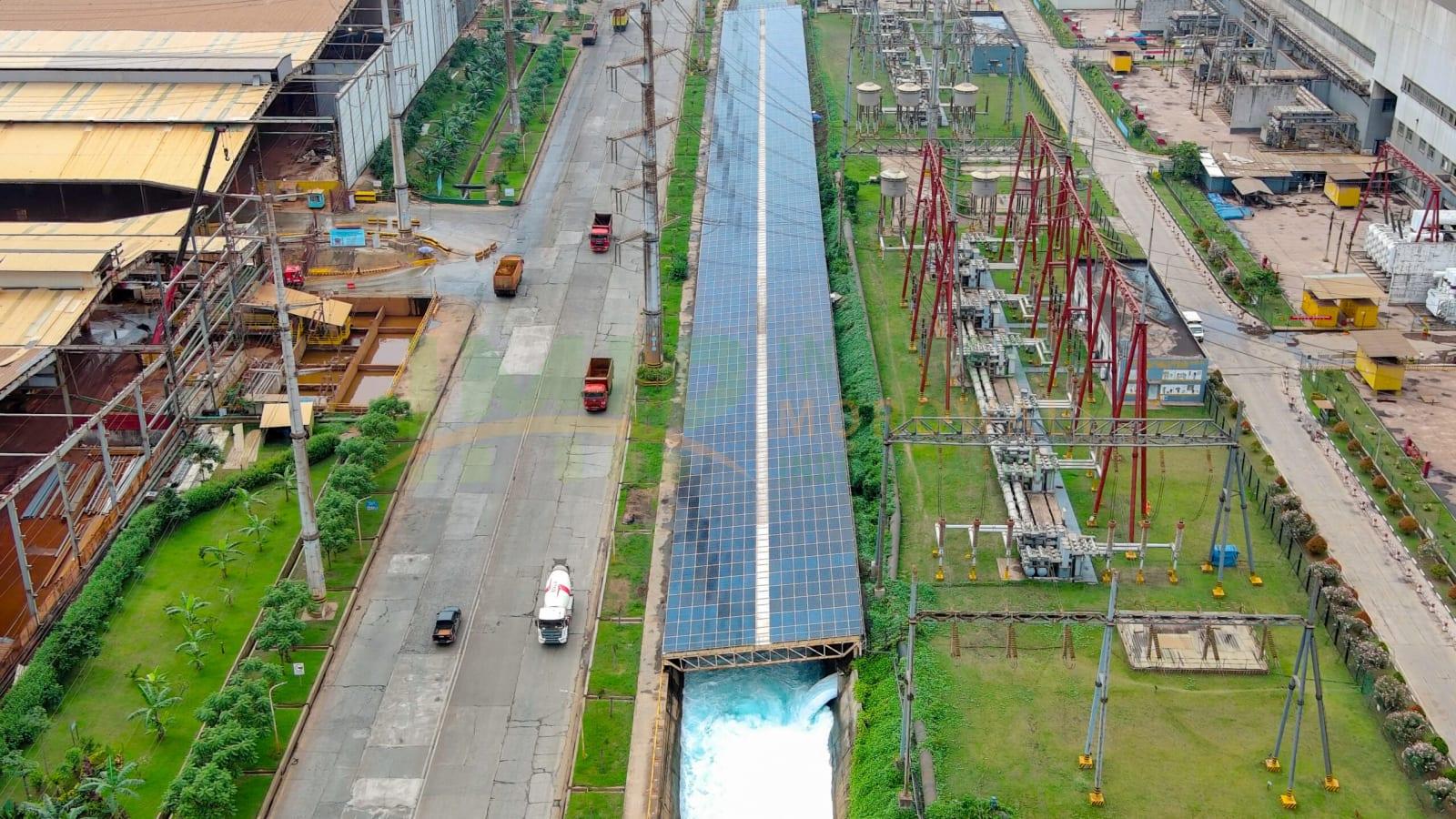
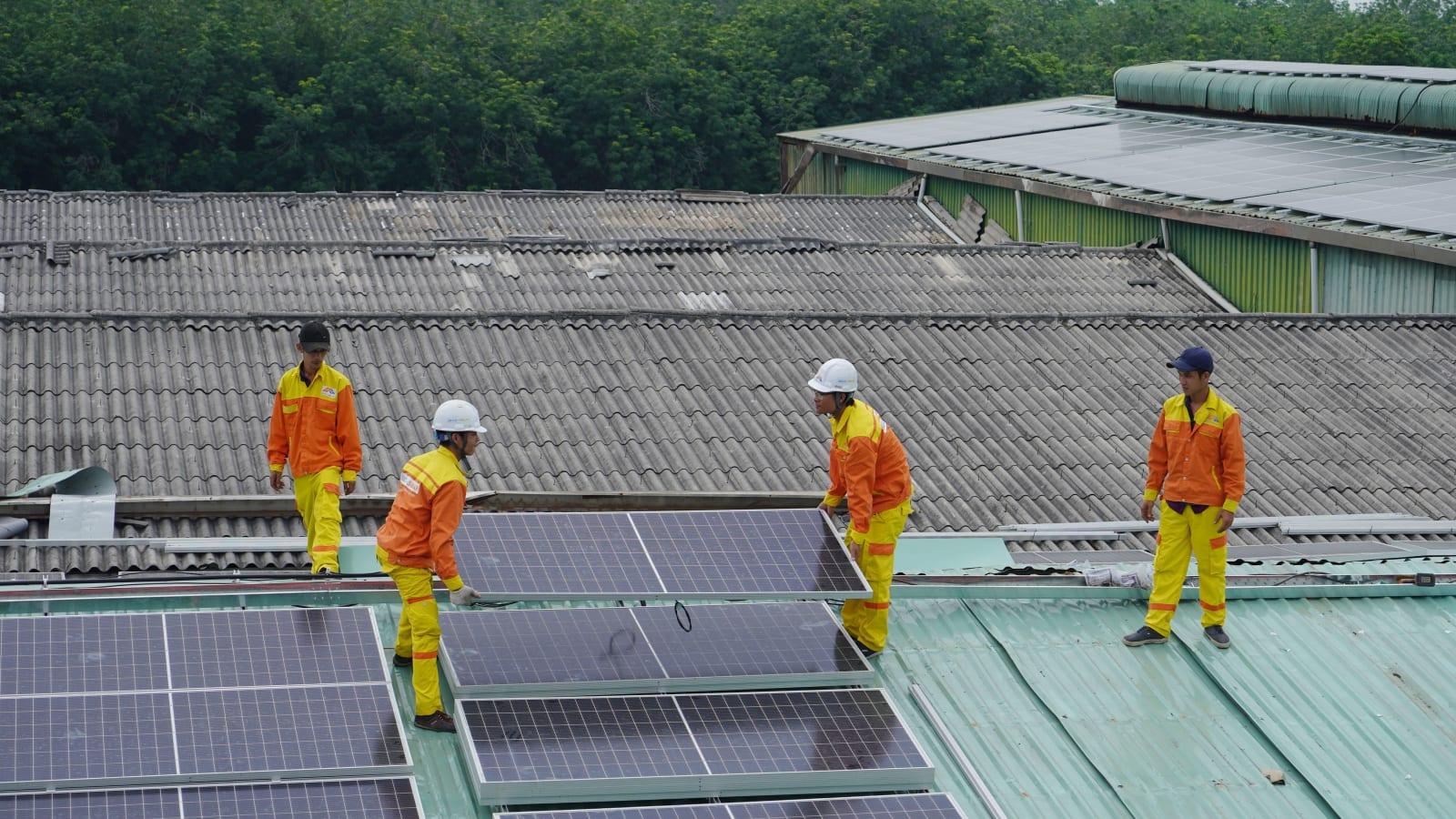
Read that way, the programme is less a single mega project and more a portfolio with very different risk profiles inside it. Diesel conversion in eastern Indonesia is a fuel cost problem with a well understood answer. Rooftop solar on factories and warehouses is a demand side efficiency measure that industrial operators are already buying on their own commercial logic. Utility scale and hybrid capacity are the parts that depend most heavily on transmission investment and on storage economics.
The rooftop segment gives some evidence of what happens when the commercial case is clear. National rooftop solar capacity reached 1.3 gigawatts as of April 2026, close to ten times the roughly 146 megawatts recorded in 2024. Eniya Listiani Dewi, Director General of New and Renewable Energy and Energy Conservation at the Ministry of Energy and Mineral Resources, has put the national solar ambition at 80 to 100 gigawatts and estimated that at least 760,000 new jobs could be created around it.
A sequence that starts with what is already close to ready
Zulfikar Manggau, an academic at Institut Teknologi PLN and formerly Executive Vice President for New and Renewable Energy at PLN, has proposed a three phase sequence for reaching the target. The first phase, from 2025 to 2029, would deliver roughly 25 gigawatts concentrated in rooftop systems on industrial estates and office buildings, floating solar on existing reservoirs, and degraded or low value land in eastern Indonesia. The second phase, from 2030 to 2034, would add a further 25 gigawatts, this time weighted towards large scale supply for industry, energy storage systems, and inter regional transmission. The remaining 50 gigawatts would follow from 2035, on the assumption that battery prices continue to fall and green financing flows continue to deepen.
The 100 gigawatts is necessary and it is not impossible. The key is not to rush. Start with what is certain, where the foundations are strong.
He identified three conditions that determine the pace. Financing requirements could reach into the hundreds of billions of United States dollars. Land is constrained and expensive in Java, while the outer islands have more space but thinner grid connections. And solar output is weather dependent, which makes storage a structural requirement rather than an optional extra.
Storage, flexibility and the manufacturing question
Both the German and the Indonesian analytical contributions converge on the same technical point. Tinschert listed grid flexibility, storage capacity, supportive regulation, land use approaches such as agrivoltaics and rooftop deployment, and workforce development through partnerships with PLN, vocational schools and polytechnics. The Institute for Essential Services Reform has argued the industrial version of the same argument. Its Executive Director, Fabby Tumiwa, has said that battery energy storage system manufacturing should be established inside Indonesia rather than imported wholesale, with raw material imports permitted while domestic factories are built, following the approach already used for electric vehicles.
That is a familiar and workable structure for Indonesian industrial policy. It also links the solar programme back to the domestic manufacturing base, which is where AESI sees its own contribution. Mada Ayu Habsari, who chairs the association, said Indonesia already holds the capability to deliver at scale, and that the point of putting IndoSolar alongside ISEW is to give that domestic capability direct exposure to global investors. AESI counts around 170 members drawn from across the solar ecosystem, including local manufacturers, developers, utilities, distributors, engineering and construction firms, technical inspection agencies and financial institutions.
Sirkularium's view for government and public institutions
The most useful thing about this briefing is not the target, which is already settled policy. It is the shared insistence, from the planning ministry, from a bilateral partner and from industry, that the binding constraint is project preparation rather than ambition.
For public institutions this suggests three practical priorities. First, invest in preparation capacity. Pre feasibility work, land status resolution, grid impact studies and standardised offtake documentation are comparatively cheap, and they are what converts a listed project into a financeable one. Second, sequence the portfolio the way the risk profile suggests. Rooftop and diesel conversion assets can move now on established commercial logic, while the transmission and storage dependent tranche is scheduled behind the network investment that enables it. Third, treat storage manufacturing and workforce development as part of the energy programme rather than adjacent to it, since both determine whether the later phases arrive at a cost the system can absorb.
What to watch next is the matchmaking day on 20 August. The specific projects that surface there, and the terms on which investors engage with them, will be the clearest available indicator of how much of the 100 gigawatt pipeline is genuinely ready to move.
How PLN Group frames the 100 GW solar build, 2025 to 2034
Values in GW
Sources
- Liputan6, ISEW 2026 becomes a bridge for clean energy investment in Indonesia
- Harian Jogja Ecologic, Germany's GIZ supports Indonesia's 100 GW solar programme and its conditions
- Republika, academic proposes a phased roadmap for the 100 GW solar target
- Dunia Energi, ITPLN academic sets out the keys to delivering 100 GW of solar
- Bloomberg Technoz, the 100 GW solar ambition calls for battery storage manufacturing investment
- Indonesian German Energy Hub, Indonesia Sustainable Energy Week 2026 programme
- IDN Times, national rooftop solar capacity reaches 1.3 GW on the way to the 100 GW vision