
A fast, coordinated response contains a landfill fire in Surabaya within hours
By Sirkularium Editorial Team, 8 min read
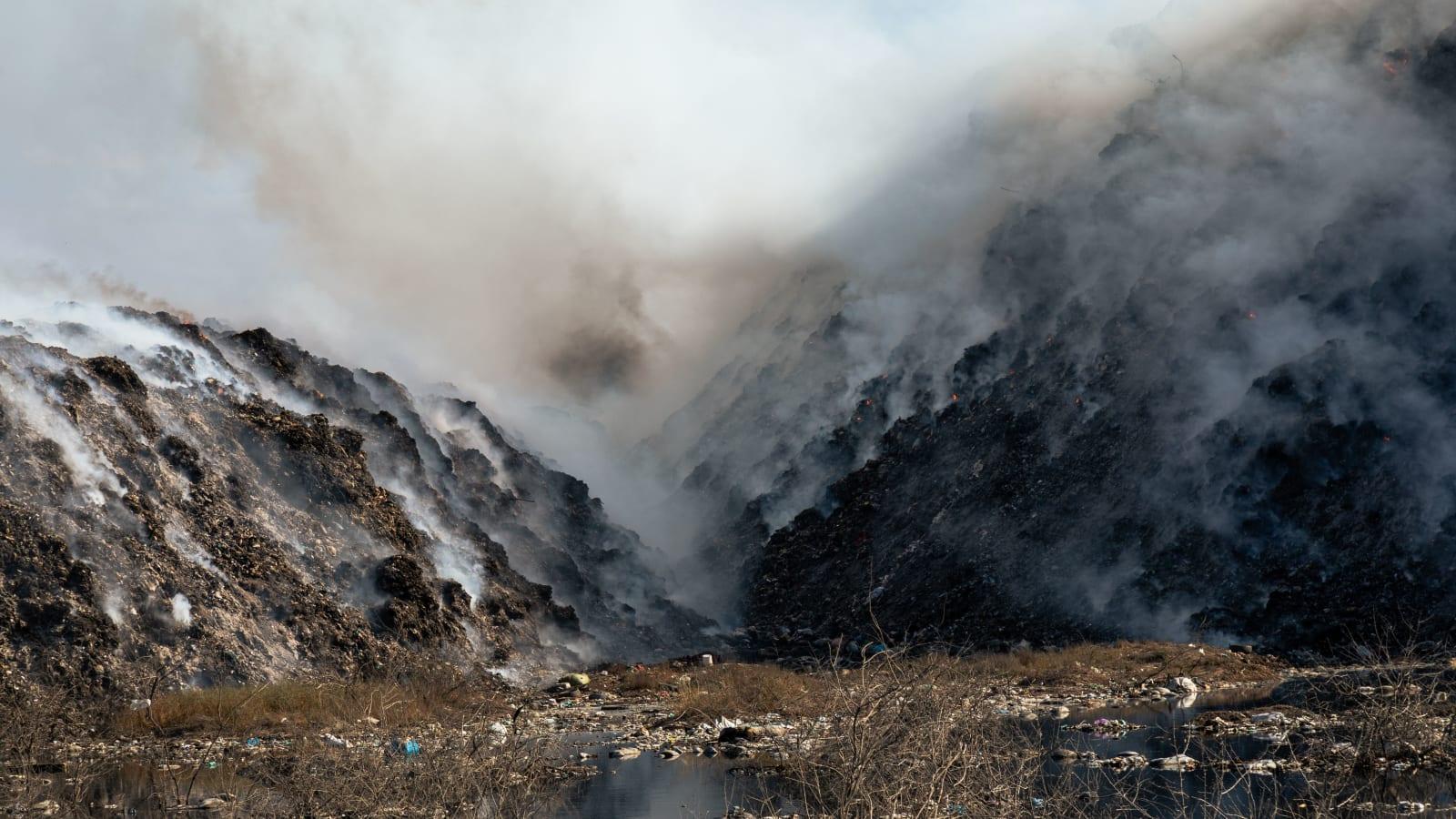
A fire broke out at Block 1B of TPA Benowo in Surabaya on the evening of 19 July 2026 and was brought fully under control within about five hours with no injuries, prompting renewed attention to dry season fire readiness at Indonesia's landfills.
What happened
On the evening of Sunday, 19 July 2026, a fire broke out in Block 1B of TPA Benowo, the landfill serving Surabaya, located in Sumberrejo Village, Pakal District, in the city's west. The Surabaya Fire and Rescue Agency (DPKP) received the first report at 18:49 WIB and had trucks on scene within seven minutes. The blaze burned across roughly 900 square meters of the landfill's approximately 10 hectare footprint, a contained fraction of the overall site.
Eight fire truck units were deployed alongside 15 water tanker units from the Surabaya Environmental Agency (DLH) and seven excavators used to break apart burning waste piles so water could reach smoldering material underneath. Response was coordinated through a joint command post, a structure that let fire crews, the environmental agency, and heavy equipment operators work the same fire line rather than in parallel. The main body of the fire was extinguished by 21:05 WIB, and DPKP declared the area fully secure by 23:58 WIB, roughly five hours after the initial call. No injuries or fatalities were reported at any point in the operation.
TPA Benowo is one of Indonesia's higher-profile waste sites, processing between an estimated 1,000 and 1,600 tons of municipal waste a day and hosting one of the country's earlier waste-to-energy installations. Its scale is precisely why a fast, well-drilled response mattered: a slower start on a site of this size could have let the fire spread across a much larger area before crews gained control.
A cause still under review
Early reporting on the morning of 20 July pointed to a specific and unusual trigger. A Persebaya Surabaya versus PSIS Semarang match was underway that evening at Gelora Bung Tomo Stadium, not far from the landfill, and fire officials initially suspected that flares lit by supporters ignited dry grass near the stadium, with wind then carrying embers south toward TPA Benowo's perimeter. M. Rokhim, head of the Surabaya Fire Department, said investigators suspected this sequence but had not yet confirmed it directly with landfill staff, and used the moment to caution residents against igniting flares anywhere near a landfill given how readily its material can catch.
That account did not hold up to a second look. Laksita Rini Sevriani, head of DPKP Surabaya, subsequently said the fire's cause was not flares, pointing to the distance between the stadium and the landfill as too great for embers to travel and ignite the pile. Her account instead describes a fire that started small and spread quickly once strong winds caught it, with the precise ignition source still unconfirmed as of this writing. Readers should treat the flare theory as an early, since-disputed hypothesis rather than a settled explanation; Sirkularium will note any update once Surabaya's authorities issue a final determination.
"It was initially small, but strong winds caused it to spread quickly," said Laksita Rini Sevriani, head of Surabaya's DPKP, describing how a fire that began at manageable scale escalated before crews arrived.
Why this matters beyond one fire
Surabaya recorded 118 fire incidents of all kinds between January and June 2026, a reminder that dry season conditions raise ignition risk across a city, not only at its landfill. Landfill fires carry their own particular hazard profile: decomposing waste generates methane, and dry surface layers can smolder and reignite even after visible flames are out, which is why DPKP kept crews on site well past the point the main fire was out, continuing to douse hotspots until nearly midnight.
Pradipta Indra Ariono, Executive Director of Walhi Jawa Timur, characterized the incident as evidence of deeper gaps in waste handling rather than simple bad luck, arguing that continued reliance on open dumping raises methane risk and that Indonesia's dry season creates recurring exposure at older landfill sites. He referenced an earlier fire at TPA Pakusari in Jember on 4 July 2026 as a sign the pattern extends beyond Surabaya alone. That is a fair point worth taking seriously, and it lines up with the national direction Indonesia's government has already set: the Ministry of Environment has instructed every province to end open dumping, with East Java among the regions working through that transition on a defined timeline, and Surabaya itself has already invested in waste-to-energy processing at Benowo specifically to reduce what ends up as an exposed, combustible pile in the first place.
Read together, the more useful frame is not failure but transition risk: cities that are actively converting from open dumping to engineered, controlled, or energy-recovery systems will, for a period, still have legacy waste piles that carry fire risk while the new infrastructure comes fully online. The response at Benowo is a reasonable proof point that the operational side of that transition, rapid multi-agency mobilization, joint command, sustained hotspot suppression, is functioning as intended even when a fire does break out.
What comes next
Surabaya's authorities have not yet announced a formal set of dry-season prevention measures specific to this incident, and the ignition cause remains open. Two practical steps would extend the lessons of this response. First, a public clarification once the cause is confirmed would settle the flare question definitively and let any needed public safety messaging, near stadiums or elsewhere, be targeted accurately rather than based on an initial hypothesis. Second, formalizing the joint command structure used here, DPKP, DLH, and heavy equipment together from the first call, as standard protocol for all landfill sites across the city would extend Sunday night's result into a repeatable one, especially as East Java's dry season continues.
Sirkularium's view
For government and public institutions managing solid waste, this incident is a useful data point on the operational side of the open dumping transition, not primarily a story about blame. The response time and the outcome, roughly 900 square meters contained within five hours, zero casualties, at one of the country's largest landfill sites, are evidence that investment in fire response coordination pays off exactly when it is tested. The open questions worth watching are the final cause determination, whether Surabaya moves to formalize the multi-agency response protocol demonstrated here for its other waste sites, and how the pace of Benowo's and East Java's broader shift away from open dumping affects fire exposure at legacy waste piles over the next two dry seasons. Provinces still working through similar transitions elsewhere in Indonesia can treat Sunday's response, joint command, rapid mobilization, sustained hotspot suppression, as a practical template worth adapting locally.
Sources
- Detik Jatim, Kebakaran Melanda TPA Benowo Surabaya
- Kompas Surabaya, Walhi Jatim Sebut Kebakaran TPA Benowo Bentuk Kegagalan Penanganan Sampah
- Kompas Surabaya, Penyebab TPA Benowo Surabaya Terbakar, Diduga dari Flare Suporter
- Bisnis Surabaya, Kebakaran Landa TPA Benowo Surabaya, Diduga Akibat Flare Suporter
- Jatimnet, DPKP Pastikan Penyebab Kebakaran Gunungan Sampah di TPA Benowo Bukan Flare
- Akurat, TPA Benowo Surabaya Kebakaran Hebat
- Memorandum Disway, TPA Benowo Surabaya Kebakaran Akibat Flare Suporter