INDODEPP II signed: Indonesia and Denmark extend their energy partnership for five more years
By Sirkularium Editorial Team, 12 min read
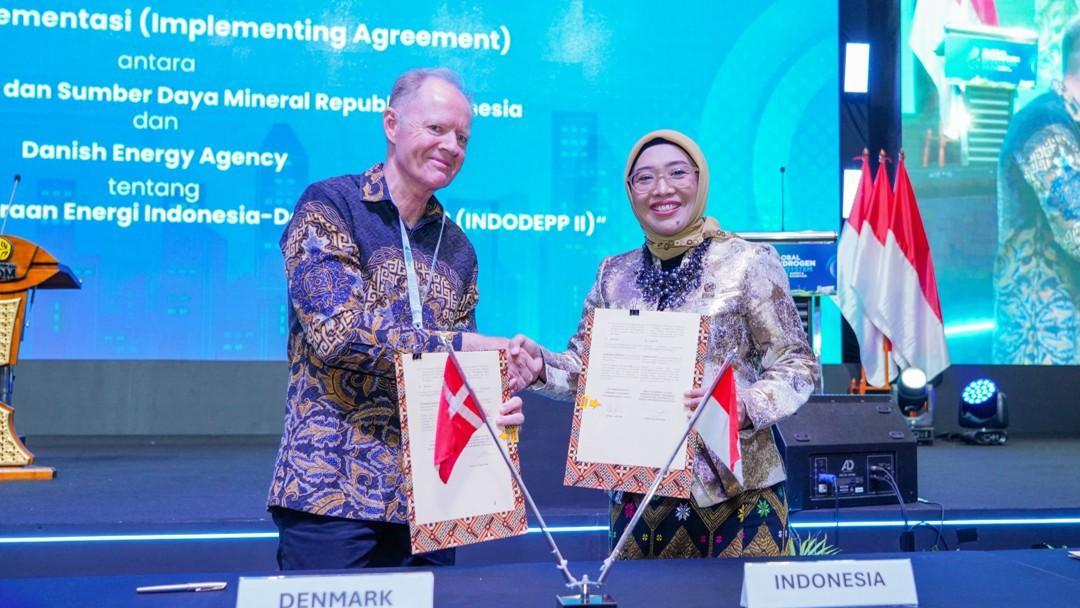
Photo: Embassy of Denmark in Indonesia and ASEAN official LinkedIn
Indonesia and Denmark signed the second phase of their energy partnership on July 20, 2026, extending a decade of cooperation for another five years. Here is what INDODEPP has delivered, what INDODEPP II will focus on, and why it matters for Indonesia's path to net zero.
A five-year extension, signed in Jakarta
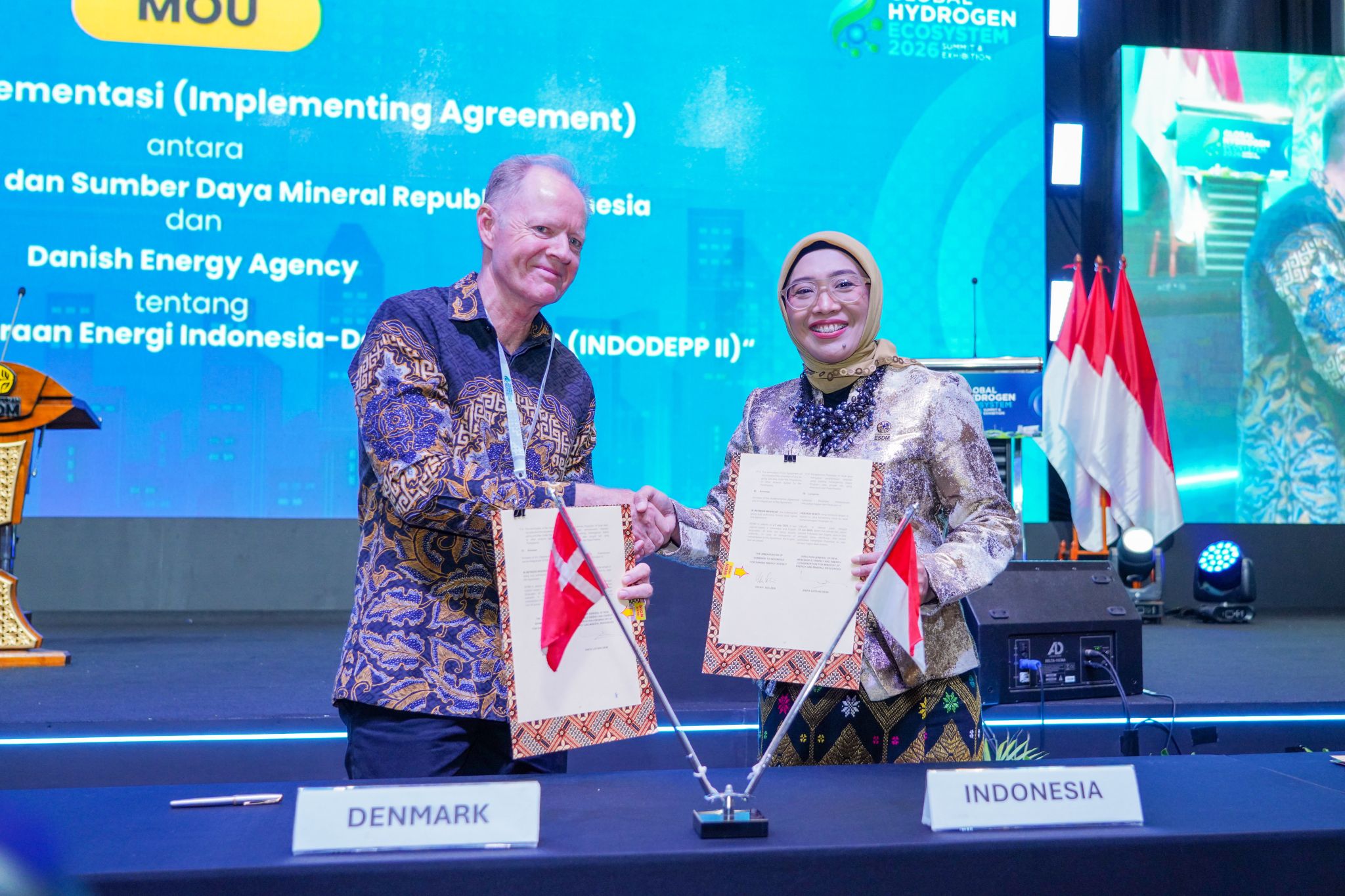
On Monday, July 20, 2026, Indonesia and Denmark formally signed the second phase of their energy cooperation, extending the Indonesia-Denmark Energy Partnership Programme for another five years under the name INDODEPP II. Eniya Listiani Dewi, Director General of New, Renewable Energy and Energy Conservation at the Ministry of Energy and Mineral Resources, signed for Indonesia, while Sten Frimodt Nielsen, Denmark's Ambassador to Indonesia, signed on behalf of the Danish Energy Agency. The Danish Embassy in Jakarta described the signing as a milestone reflecting the strong partnership between the two countries and their shared commitment to advancing a secure, efficient, and sustainable energy system.
The new phase concentrates on four priority areas: long-term energy planning and regulation, integration of renewable energy into the grid, energy efficiency in industrial and public facilities, and low-carbon development at the provincial level. Participating institutions span the Ministry of Energy and Mineral Resources, the National Energy Council, the state utility PLN, and regional energy planning agencies. Each of these four areas continues a workstream the partnership has been building for a decade, which is exactly why the extension matters: it converts proven cooperation into a funded, five-year mandate at the moment Indonesia is drafting its next national energy plans. The sections below explain where this partnership came from, what it has already delivered, and what the second phase now carries forward.
Two countries, one energy transition playbook
Indonesia's energy transition is often told through headline numbers: a 100 GW solar ambition, a net zero target of 2060 or sooner, a renewable share that must grow several times over within two decades. Behind those numbers sits the foundational work that makes them achievable: building the models that tell planners which power plant to build where, writing the regulations that make investors confident, and training the engineers who keep a grid stable as more variable renewable energy flows into it. Since 2015, one of the most consistent and active contributors to that foundational work has been Denmark, through what is today called the Indonesia-Denmark Energy Partnership Programme, or INDODEPP.
INDODEPP is a government-to-government cooperation between Indonesia's Ministry of Energy and Mineral Resources and the Danish Energy Agency, coordinated with the Royal Danish Embassy in Jakarta and financed by the Danish Ministry of Foreign Affairs. It is not a lending facility and it does not build power plants. Instead, it transfers something Denmark has accumulated over four decades of its own energy transition: the institutional craft of planning, integrating, and economizing a renewable-based energy system. Denmark's experience carries particular weight because the country turned an oil-shock vulnerability in the 1970s into a wind power industry and one of the most efficient energy economies in Europe, and it did so through exactly the instruments INDODEPP now shares with Indonesian institutions.
The relationship began with a Memorandum of Understanding on renewable, clean energy and energy conservation signed in 2015, followed by a Strategic Sector Cooperation programme that commenced in 2016. In November 2020 the partnership stepped up decisively. Indonesia's then Minister of Energy and Mineral Resources Arifin Tasrif and Denmark's then Minister of Climate, Energy, and Public Utilities Dan Jorgensen signed a Second Amendment Protocol, and Denmark's Council for Development Policy approved a dedicated country programme, INDODEPP 2020-2025, with a grant of DKK 60 million. A further Enhanced Engagement of DKK 15 million was recommended for 2022-2025. Minister Tasrif described the goal plainly at the signing: to supply Indonesia with sustainable energy.
How the programme is structured and funded
INDODEPP's first phase was organized around outcomes that map closely onto the practical bottlenecks of any energy transition.
The first outcome covers scenario-based long-term energy planning and regulation. Danish and Indonesian modellers work side by side to build and maintain long-term energy models, strengthen the ministry's in-house modelling capacity, and translate scenario results into policy and regulatory recommendations. This is the machinery that informs documents such as the national electricity supply plan and the general energy plans that guide investment for a decade at a time.
The second outcome addresses the integration of renewable energy into the grid. It includes support for a wind power pilot tender run with the state utility PLN, designed to demonstrate that a transparent, well-prepared auction can attract credible renewable investors at competitive prices. It also covers energy forecasting and system operation, so grid operators can anticipate the output of wind and solar plants, and least-cost grid integration strategies that identify where new renewable capacity fits most economically.
The third outcome is an enhanced national strategy for energy efficiency, with dedicated workstreams on buildings and on industry and power plants. Efficiency draws less public attention than a new power plant, yet it is consistently one of the most valuable parts of any energy transition: every unit of energy saved is a unit that does not need new generation, new fuel, or new transmission.
Alongside these, the programme supports low-carbon development planning at the provincial level, helping selected provinces prepare regional energy outlooks and masterplans grounded in local resources and demand. Key Indonesian partners span the Ministry of Energy and Mineral Resources, including the Directorate General of New, Renewable Energy and Energy Conservation (EBTKE) and the Directorate General of Electricity, the National Energy Council, PLN, and regional energy offices.
From models to megawatts: what INDODEPP has delivered
A programme of technical cooperation should be judged by its artifacts, and INDODEPP's are unusually concrete.
The most widely used may be the Technology Data for the Indonesian Power Sector, a technology catalogue first published in 2020 and updated in 2024, prepared by the Directorate General of Electricity together with the Danish Energy Agency and the Danish Embassy. The catalogue sets out standardized, transparent cost and performance data for every major generation technology available to Indonesia, from coal and gas to solar, wind, hydro, geothermal, biomass, and storage. Paired with a levelized cost of electricity calculator that the partnership also produced, it gives Indonesian planners and investors a common, public fact base for comparing options. When a planner in Jakarta and a developer in Copenhagen or Singapore price the same wind farm from the same reference data, negotiations start from evidence rather than assertion.
The partnership has also produced national and regional planning documents, including the Indonesia Energy Outlook 2019 and regional energy outlooks and masterplans for provinces including West Nusa Tenggara, North Sulawesi, Gorontalo, Riau, and South Kalimantan. The best known regional product is the Lombok Energy Outlook, published in January 2019, which found that Lombok's power system could reach a renewable energy share of around 60 percent by 2030 in a cost-efficient way. The Secretary General of the National Energy Council at the time noted that the studies showed significant renewable potential in Lombok that could be integrated cost-efficiently, and Denmark's then Ambassador Rasmus Abildgaard Kristensen called the island cooperation very successful, with an opportunity to expand the approach to other provinces. That is precisely what happened, as the island planning concept was scaled to further regions.
The wind workstream deserves its own mention. Denmark has assisted PLN in preparing and running a wind power pilot tender, an exercise whose value extends well beyond the megawatts eventually procured. A pilot auction forces every part of the procurement machinery to be tested in practice: site data preparation, qualification criteria, risk allocation in the power purchase agreement, and the evaluation process itself. Once that machinery has run cleanly a first time, it can be repeated at scale, and international developers who watched the pilot gain the confidence to bid in later rounds. Transparent, well-prepared tenders are among the most reliable tools any country has for discovering the true, and usually falling, price of renewable power.
On the efficiency side, the programme has completed full energy audits at 12 Indonesian industrial facilities, produced technology guidelines for compressed air systems and industrial motor systems, prepared a roadmap for energy efficient, low-carbon buildings, and carried out prefeasibility studies and waste-to-energy potential assessments across multiple provinces. Each audit and guideline is a template other facilities can reuse, which is how a programme with a modest budget multiplies its effect through the wider economy.
The energy efficiency workstream: a steady accelerator
For Sirkularium's readers in government and public institutions, the efficiency outcome deserves particular attention, because it is where INDODEPP connects most directly to Indonesia's industrial decarbonization agenda. Indonesian regulation already requires large energy users to appoint energy managers, conduct audits, and report consumption. What programmes like INDODEPP add is the practical capability to act on those obligations: audit methodologies tested on real Indonesian factories, guidelines written for the equipment those factories actually run, and evidence that efficiency measures pay for themselves through avoided fuel and electricity costs.
The buildings workstream plays a parallel role for the public sector. Government buildings are numerous, publicly owned, and centrally influenced, which makes them a natural proving ground for efficiency standards that the private market can then follow. A roadmap for low-carbon buildings, developed with an international partner that has enforced tightening building codes for decades, shortens the learning curve considerably.
"The partnership between Indonesia and Denmark serves as a model of how renewable energy expansion can align with efforts to strengthen energy independence," Denmark's Minister of Foreign Affairs Lars Lokke Rasmussen said in April 2025, as the two countries signed a new Protocol of Amendment in Jakarta.
That April 2025 signing illustrated how government cooperation seeds commercial activity. Alongside the protocol, three business memoranda were concluded: PLN Indonesia Power and the Danish wind manufacturer Vestas agreed to jointly study green electricity demand opportunities, PLN Nusantara Power and Vestas agreed to assess renewable power plant development, and PLN Indonesia Power signed with Saltfoss Energy on nuclear energy cooperation. Minister of Energy and Mineral Resources Bahlil Lahadalia observed at the ceremony that Denmark is known as one of the countries with extensive experience in managing new and renewable energy, pointing in particular to wind power and energy efficiency solutions.
INDODEPP II in context: a deeper bench of partners
The first INDODEPP phase formally ran to 2025, and with the July 20 signing the cooperation now formally continues as INDODEPP II. Under Denmark's new umbrella Danish Energy Partnership Programme, known as DEPP 2026, Indonesia is one of five country programmes alongside South Africa, Mexico, China, and Vietnam. Together the five partner countries account for a substantial share of global emissions, which is why Denmark concentrates its energy diplomacy there. The stated focus of the new phase is supporting the temperature goals of the Paris Agreement and a just and inclusive energy transition, aligned with the COP28 commitments to triple renewable energy capacity and double the rate of energy efficiency improvement by 2030.
It is also worth placing INDODEPP in the wider landscape of Indonesia's international energy cooperation. The Just Energy Transition Partnership mobilizes large-scale finance for the power sector, multilateral banks provide policy loans, and bilateral programmes with Germany, Japan, and others each contribute their own strengths. INDODEPP occupies a complementary niche: it works upstream of the money, on the plans, regulations, data, and skills that determine whether financed projects are the right projects. A billion dollars invested against a weak plan achieves less than a smaller sum invested against a rigorous one, which is why the planning and efficiency capabilities INDODEPP builds raise the return on every other partnership Indonesia maintains.
For Indonesia, the timing is favorable. The country is preparing its next National Energy General Plan, expanding renewable procurement at unprecedented scale, and finalizing sectoral decarbonization roadmaps for energy-intensive industry. Each of those undertakings draws on exactly the capabilities the partnership has spent a decade building: credible scenario modelling, transparent technology costing, auction design, grid integration analysis, and industrial energy management. INDODEPP II arrives with the relationships, the tools, and the institutional trust already in place, which means its support can flow into live policy processes rather than starting from introductions.
Sirkularium's view: why this model works for Indonesia
Sirkularium sees INDODEPP as one of the clearest demonstrations that patient, technical, peer-to-peer cooperation moves an energy transition forward in ways that neither financing alone nor targets alone can. Three lessons stand out for government and public institutions.
First, shared fact bases accelerate everything downstream. The technology catalogue and the energy models are not policy documents, yet they shape every policy negotiation that follows, because all parties argue from the same numbers. Institutions that invest in transparent, regularly updated planning data reduce friction across the entire investment chain.
Second, efficiency is a transition strategy, not a side programme. The audits, guidelines, and building roadmaps produced under INDODEPP show that Indonesia can meet a meaningful share of its climate targets by using energy better before generating more of it. As mandatory industrial decarbonization rules take shape, the methods piloted under this partnership are ready to be scaled.
Third, continuity compounds. Ten years of cooperation, renewed through protocols in 2020 and 2025 and now a second programme phase, have built the trust that lets Danish advisers work inside Indonesian planning processes rather than alongside them. For institutions designing their own international cooperation, that is the feature to replicate: long horizons, embedded expertise, and deliverables that Indonesian institutions own and maintain themselves.
The practical work of INDODEPP II will need people who can operate across both worlds, translating international technical cooperation into day-to-day coordination with Indonesian ministries, utilities, and local governments. That is where careers in this field are being built right now.
Sirkularium currently has an open position for a Local Energy Consultant supporting INDODEPP's energy efficiency work in industry and buildings. The role is Jakarta based, full time, with a target start in August 2026, and it places the consultant at the working level of the partnership described in this article, coordinating between the Danish Energy Agency, EBTKE, and Indonesian stakeholders. Interested candidates can find the full description and apply at the Sirkularium vacancy page.
Sources
- Petromindo, Indonesia, Denmark extend energy transition partnership for five years
- Danish Energy Agency, Indonesia and Denmark cooperate on green energy transition
- Danish Ministry of Foreign Affairs (Danida), Indonesia-Denmark Energy Partnership Project key results
- Kementerian ESDM, Kerja Sama RI-Denmark INDODEPP Segera Diimplementasikan
- Kementerian ESDM, Indonesia, Denmark Extends Renewable Energy Partnership
- Danish Energy Agency, Denmark and Indonesia collaborate on developing sustainable islands
- Business Indonesia, Indonesia and Denmark Deepen Strategic Partnership in Energy Transition
- State of Green, Indonesia Denmark Energy Partnership Programme (INDODEPP)
- Ditjen Gatrik ESDM, Technology Data for the Indonesian Power Sector 2024
- Sirkularium, Local Energy Consultant vacancy