Indonesia clarifies its rare earth byproduct rules, and the value of a mineral cargo becomes a question of assay
By Sirkularium Editorial Team, 8 min read
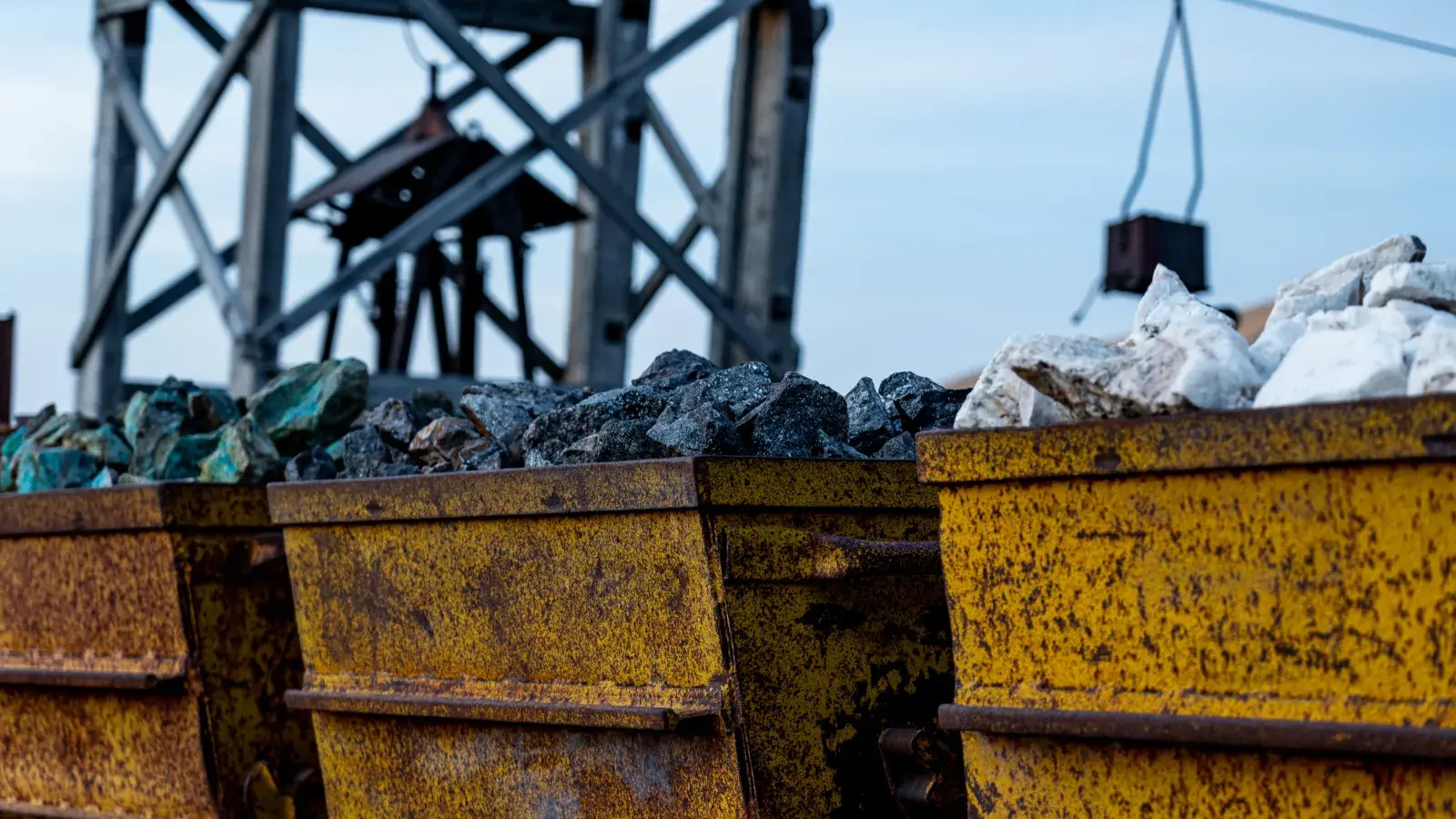
The Presidential Staff Office confirmed on 3 August that the rare earth export ban applies to primary products only, not to trace content inside alumina, copper cathode and nickel derivatives. Shipments have resumed, 85 held surveyor reports were cleared, and a revision defining concentration thresholds is being drafted across fifteen ministries.
Indonesia has settled a question that had been holding mineral cargoes at its ports since the middle of July. On 3 August the Presidential Staff Office confirmed that the country's export prohibition on rare earth elements applies to those elements when they are the primary product being shipped, and not to the trace rare earth content that occurs naturally inside alumina, copper cathode and processed nickel. Shipments of those commodities have resumed. A revision of the underlying trade regulation is being prepared, with the government aiming to complete it within a week of that announcement and coordinating the drafting across roughly fifteen ministries and agencies.
Dudung Abdurachman, Head of the Presidential Staff Office, set out the agreed position plainly.
"We have reached a shared understanding that the export ban applies to rare earth elements exported as the primary product."
The practical effect was immediate. Following communication on 31 July, PT Sucofindo was given the certainty it needed to issue 85 surveyor reports that had been held back, each one the document a cargo requires before it can legally leave. Coverage on 20 July had counted more than 120 vessels unable to depart. By early August the Presidential Staff Office described roughly a hundred of those ships as moving again. Arif Perdanakusumah, Chairman of the Indonesian Nickel Industry Forum (FINI), confirmed the change from the industry side, noting that many surveyor reports had since been issued and that many previously held vessels had sailed.
The rule that created the queue
The regulation at the centre of this is Trade Minister Regulation No. 6 of 2026, the fourth amendment to Trade Minister Regulation No. 22 of 2023 on goods prohibited from export. It took effect on 1 April 2026 and restricted the export of rare earth elements and their compounds below 99 percent purity. Sources differ slightly on the count of listed elements, with most Indonesian coverage citing 17 and at least one report citing 18. That is a discrepancy worth resolving in the revised text rather than leaving to interpretation.
The difficulty was never the policy intent, which is consistent with Indonesia's long-running effort to keep processing value inside the country. The difficulty was operational. Rare earth elements are geochemically ordinary companions to the ores Indonesia already mines and refines. They appear in bauxite derivatives, in copper circuits and in nickel intermediates because that is where nature placed them. Once testing for rare earth content became a condition of certification, surveyors were asked to assess cargoes against a limit that had not yet been expressed in terms a laboratory could apply. Where the rule was silent, caution was the responsible response, and cargoes waited.
Airlangga Hartarto, Coordinating Minister for Economic Affairs, framed the chemistry directly, observing that rare earth elements sit within the periodic table alongside the metals Indonesia exports and that associated elements are always present in some quantity. That observation is the whole of the technical case. A prohibition written in terms of a product needs a companion rule written in terms of concentration.
What the revision has to define
The government has set out a clear list of what the revised regulation will settle: the definition of an associated or byproduct mineral, concentration thresholds for individual elements, laboratory testing methods, verification procedures, the treatment of naturally occurring radioactive material, and the guidelines under which surveyor reports are issued. Alongside this, the Ministry of Energy and Mineral Resources, the Nuclear Energy Regulatory Agency (BAPETEN) and the mineral industry body are preparing a joint assessment of rare earth elements and associated radioactive material.
That list is more consequential than it first appears. Each item on it is a measurement decision, and together they determine what a cargo is worth on paper.
Industry has asked for the thresholds to be grounded in what can actually be measured. Arif Perdanakusumah put the condition precisely, saying that any threshold set must be based on current industrial facts, covering technology, economics and the readiness of testing equipment. A limit that no accredited laboratory in the country can reproduce is not a limit. It is a delay.
An assay threshold is a valuation instrument
This is where the story matters beyond the shipping schedule. A concentration threshold does three things at once. It decides whether a cargo may be exported. It decides, through reference pricing and royalty schedules, how much the state collects on that cargo. And it decides whether the rare earth content inside the material is treated as an incidental impurity or as an asset with a recoverable value.
Indonesia already has the resource position to make the third question real. Identified monazite reserves in the Bangka Belitung islands stand at about 180,000 tonnes, alongside roughly 20,000 tonnes of xenotime, with monazite sands carrying rare earth oxide content in the range of 50 to 65 percent by weight. Tin operations producing on the order of 50,000 to 70,000 tonnes a year generate an estimated 5,000 to 8,000 tonnes of monazite as a byproduct, of which perhaps 15 to 25 percent is currently recovered. Those are not marginal figures. They describe a stock of value that is being moved, stored and in some cases set aside without being counted.
Bahlil Lahadalia, Minister of Energy and Mineral Resources, has been candid about the distance between holding the material and being able to use it, noting that these elements are byproducts and that Indonesia does not yet have an industry dedicated specifically to processing them. He has also confirmed that rare earth concentrations in export products are being mapped, so that operators have certainty about how their material will be treated.
Once a threshold is written into a regulation, every tonne that crosses it becomes a valuation question rather than a chemistry question.
Measurement is the constraint, and it is a solvable one
The sequence of the past three weeks reads better as a system test than as a disruption. A rule was introduced, the measurement infrastructure needed to apply it was not yet complete, and the government responded within days by restoring flow while committing to define the missing parameters. Coordination running across fifteen ministries and agencies, convened by the Presidential Staff Office, is the appropriate weight for a question that touches trade policy, mineral governance, nuclear safety and laboratory accreditation at the same time.
What the episode demonstrates is that Indonesia's mineral value chain has advanced to the point where the binding constraint is analytical rather than physical. The country can mine the material, and increasingly it can process the material. What it is now building is the capacity to state precisely what is in the material, and to attach a defensible number to that answer.
Sirkularium's view
For government and public institutions, the useful lesson here concerns sequencing. Thresholds, testing methods and verification procedures are best settled and accredited before they become conditions of trade, because the cost of defining them late is carried at the port. The revision now in preparation is the right instrument, and the list of items it will cover is comprehensive. Its value will depend on whether the resulting methods are reproducible across the laboratories that have to apply them.
For operators, the implication runs further than compliance. If rare earth content inside nickel, copper and bauxite derivatives is about to be measured as a matter of routine, then that content becomes part of the economic profile of every consignment, and in time part of the economic profile of every deposit and every processing residue. Companies that already hold verified assay and mass balance data on their byproduct streams will be able to treat the revised rule as a reporting exercise. Companies that do not will be treating it as an investigation.
Sirkularium's position is that rigorous, independently verified economic valuation belongs in the operating routine rather than in the response to an incident. Combining geospatial and remote sensing data with ground sampling, standard methodology and transparent assumptions produces figures that hold up in front of the Ministry of Environment and Forestry, in front of the Directorate General of Minerals and Coal, and in front of a surveyor at the quayside. What to watch next is the text of the revised regulation, the specific concentration limits it sets element by element, and the accreditation status of the laboratories asked to certify against them. Those three details will determine how much of Indonesia's rare earth endowment moves from a footnote in an assay report to a line on a balance sheet.
Sources
- ANTARA News, Indonesia resumes mineral exports amid rare earth rule revision
- ANTARA News, Government refines rare earth export rules to ease mineral trade
- ANTARA News, Indonesia maps rare earths in mineral exports amid regulatory review
- CNBC Indonesia, rare earth export regulation to be revised and mineral exports reopened
- CNBC Indonesia, industry response from the Indonesian Nickel Industry Forum
- Bisnis Indonesia, Sucofindo issues 85 previously delayed surveyor reports
- Tambang.co.id, government confirms associated mineral exports continue while a rare earth assessment is prepared
- Rare Earth Mining, Indonesia monazite and xenotime resource position