A heat pump in Karawang gives Indonesian industry a working reference for cutting process heat emissions
By Sirkularium Editorial Team, 8 min read
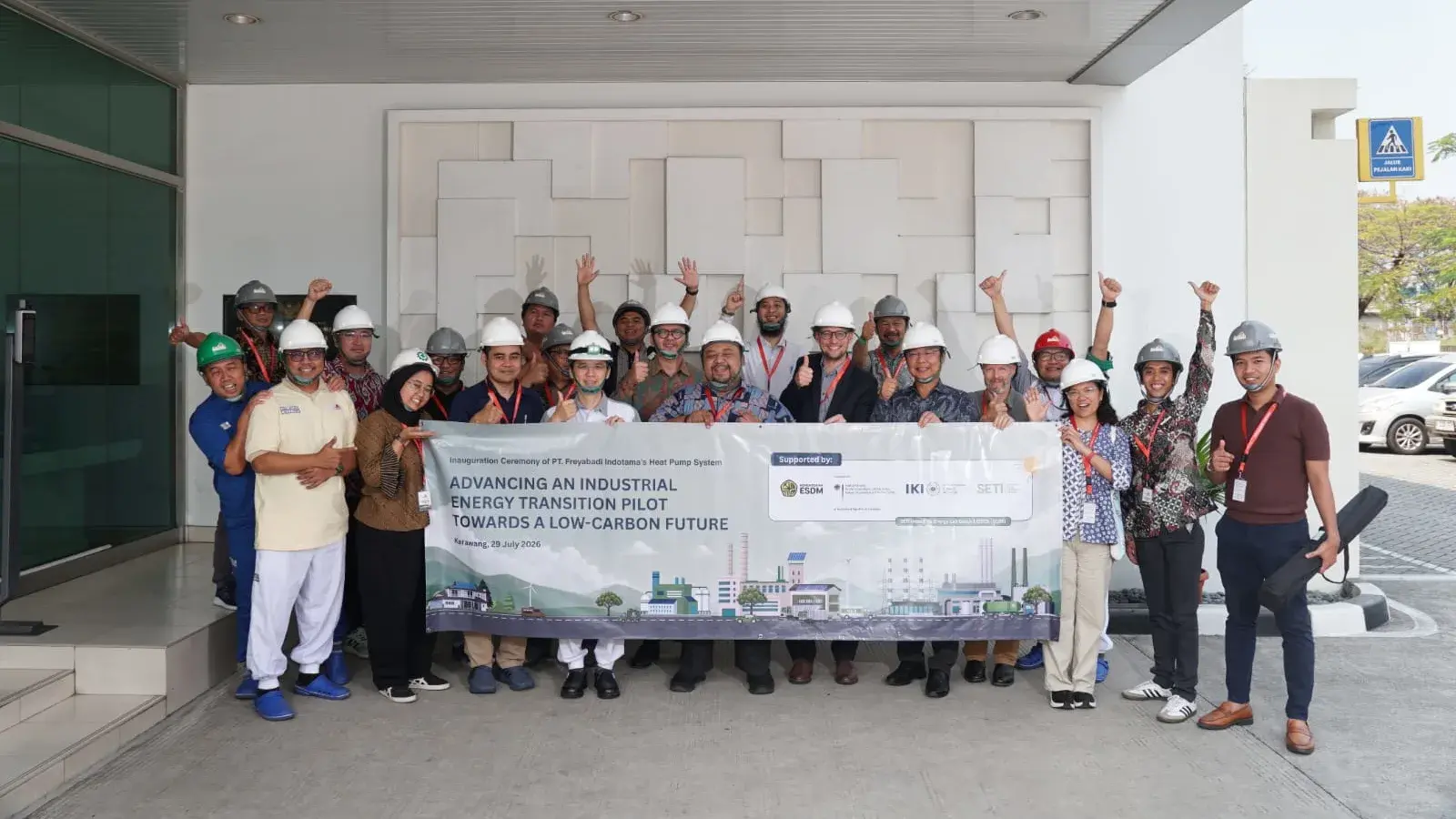
The Ministry of Energy and Mineral Resources has presented a heat pump installed at PT Freyabadi Indotama in Karawang as a demonstration that energy efficiency and industrial decarbonization advance together, with the unit projected to avoid 145.5 tonnes of carbon dioxide and save Rp744.2 million in operating costs each year.
Indonesia's industrial decarbonization agenda gained a concrete reference point this week. At the KIIC industrial estate in Karawang, West Java, a heat pump installed at the cocoa processing plant of PT Freyabadi Indotama has been presented by the Ministry of Energy and Mineral Resources as evidence that energy efficiency and emissions reduction move in the same direction inside a working factory, not only inside a feasibility study.
The installation sits within the Sustainable Energy Transition in Indonesia project, known as SETI, which the Directorate General of New, Renewable Energy and Energy Conservation runs in cooperation with GIZ Indonesia and ASEAN, with funding from the German government's International Climate Initiative. What makes the case useful is its ordinariness. Freyabadi is a cocoa processor that turns beans into powder, couverture and compound chocolate for the confectionery industry, operating from a plant on Jalan Maligi III inside KIIC. It is exactly the kind of mid sized manufacturer that populates Indonesian industrial estates, and exactly the kind of operation that policy needs to reach if industrial emissions are going to bend.
What was installed and what it delivers
The unit recovers and upgrades heat for the plant's process requirements, replacing energy that would otherwise be raised by burning fuel. Its coefficient of performance is measured at 3.47, meaning the system delivers roughly three and a half units of useful heat for every unit of electricity it draws. That ratio is the whole argument in a single number, because it is what allows a factory to reduce both its energy bill and its emissions at the same time rather than trading one against the other.
The performance figures released alongside the demonstration are modest in absolute terms and significant in what they imply. The installation is projected to avoid 145.5 tonnes of carbon dioxide a year and to save Rp744.2 million a year in operating costs. One plant will not move a national inventory. Several thousand plants running the same logic would.
Gigih Udi Atmo, Director of Energy Conservation at the Directorate General of New, Renewable Energy and Energy Conservation, framed the result in terms that industrial managers respond to.
Energy efficiency is not merely an environmental agenda. It is a strategy to reduce operating costs and strengthen competitiveness.
That framing matters for how the transition is sold. An efficiency measure presented as a compliance obligation competes for capital against every other compliance obligation. The same measure presented as a cost line with a return competes against ordinary capital projects, where it usually wins.
Why process heat is the decisive front
Manufacturing remains one of the largest energy consumers in the Indonesian economy, and much of that consumption is not electricity for motors and lighting. It is heat for production processes, generated in most plants by burning fossil fuel in boilers and furnaces. Process heat is therefore where industrial decarbonization is genuinely difficult, and it is where solutions have historically been thinner than in power generation.
Heat pumps change that arithmetic for the low and medium temperature ranges that food, beverage, textile, pharmaceutical and chemical processing rely on. Drying, pasteurising, tempering, washing and space conditioning all sit within reach of the technology. A cocoa plant is a good demonstration precisely because its heat demand is unremarkable. If the economics work at Freyabadi, they work across a wide slice of Indonesian light manufacturing.
Johannes Anhorn, Coordinator for Industrial and Building Sector Decarbonization at the SETI project, set out the commercial stakes plainly, noting that energy costs account for roughly 20 to 30 percent of total industrial production costs. In a sector operating on thin margins, a measure that touches a quarter of the cost base is not a marginal intervention.
The policy scaffolding already exists
Indonesia is not starting from an empty regulatory page. Government Regulation Number 33 of 2023 on Energy Conservation requires companies above a defined energy consumption threshold to carry out periodic energy audits and, importantly, to act on the recommendations those audits produce. That second obligation is the one that converts paperwork into projects.
The ministry projects that energy efficiency can contribute around 37 percent of the emissions reduction target for the energy sector by 2030. That is a large share to place on a measure that requires no new generating capacity, no new transmission corridor and no land acquisition. It is also a share that will only be realised if audit findings translate into procurement decisions at plant level.
The Karawang installation is useful to policymakers for that specific reason. It closes the loop from audit to specification to installed equipment to measured performance, and it does so with named parties who can be asked how it went. Takeo Ito, Vice President of PT Freyabadi Indotama, and Adi Christian, the plant's Factory Manager, carried the operational side. Endra Dedy Tamtama of the Directorate of Energy Conservation represented the regulator. Mohamad Ubaidillah of PT Cakrawana Adi Perkasa supplied the technology. A replicable project needs a supply chain as much as it needs a policy, and this one demonstrates that the domestic vendor capability exists.
What replication would take
Three conditions determine whether this becomes a template rather than a photograph. The first is measurement discipline. The 145.5 tonne and Rp744.2 million figures are projections, and the credibility of every subsequent business case depends on published performance after twelve months of operation. Verified savings are the most persuasive marketing instrument the efficiency agenda has.
The second is financing structure. A heat pump is a capital purchase against an operating saving, which is a familiar mismatch for mid sized manufacturers who ration capital carefully. Energy service company arrangements, equipment leasing and green credit lines from national banks all resolve that mismatch without requiring a subsidy. The projected payback implied by a Rp744.2 million annual saving is the sort of profile that commercial lenders can underwrite.
The third is sector sequencing. Rather than promoting heat pumps generally, the greatest return comes from identifying the industrial subsectors whose temperature profiles fit the technology best, then working through industrial estates one at a time. Estates such as KIIC concentrate dozens of comparable factories behind one gate, which lowers the cost of outreach, audit and vendor mobilisation considerably.
Sirkularium's view
For government and public institutions, the value of the Karawang project lies in what it removes from the conversation. It removes the question of whether the technology works in Indonesian operating conditions, and it removes the question of whether the commercial case stands without concessional support. Both are now answered with figures attached to a named plant.
The productive next step is to treat industrial estates as the unit of delivery. A programme that audits an entire estate, publishes anonymised savings potential by process type, and connects verified projects to a standing financing facility would convert the obligation created by Government Regulation Number 33 of 2023 into a pipeline. That approach also builds the local engineering and maintenance capacity that determines whether installed equipment keeps performing in year five.
Sirkularium reads this as a well constructed piece of demonstration policy. It is small, specific, measurable and repeatable, which is a stronger foundation than a headline target. The indicators to watch over the coming year are the published operating results from Karawang, the number of estates brought into structured audit programmes, and whether national banks begin offering standardised products for industrial heat efficiency. Those three signals will show whether the 37 percent contribution expected from efficiency by 2030 is on a delivery path.
Sources
- ANTARA News, ministry statement on energy saving technology and the national emissions target
- ANTARA News Jawa Timur, regional wire report with the installation figures
- Koran Jakarta, efficiency as 37 percent of the energy sector emissions target
- Liputan6, ministry on efficiency raising company profit while cutting emissions
- KBEonline, SETI project heat pump as an efficiency example in Karawang
- KBEonline, cost saving of Rp744 million per year from the installation
- Media Indonesia, heat pump technology showing efficiency and decarbonization together