Indonesia's recycling industry moves to put its material flows on the record
By Sirkularium Editorial Team, 9 min read
At the ASEAN Recycling Summit on 12 August 2026 in Jakarta, ADUPI, IDCTA and ESGIN signed a memorandum of understanding to build digital traceability and verified reporting across the plastic recycling chain. The work points directly at the national target of 100 percent managed waste by 2029.
Indonesia's plastic recycling industry took a step on 12 August 2026 that has less to do with machinery and more to do with record keeping. At the ASEAN Recycling Summit 2026, held inside the Indo Waste and Recycling 2026 Expo and Forum at JIExpo Kemayoran in Jakarta, three organisations signed a memorandum of understanding to build shared digital infrastructure for the sector. The signatories were the Indonesian Plastic Recycling Association (ADUPI), the Indonesia Carbon Trade Association (IDCTA), and PT ESGIN Global Partners.
The agreement was signed by ADUPI Chairwoman Christine Halim, IDCTA Chairman Riza Suarga, and Yayang Ruzaldy, Vice President and Regional Head Indonesia at PT ESGIN Global Partners. Its subject is not a new plant or a new collection scheme. It is the layer underneath both: a way to record, trace and verify what actually moves through Indonesia's recycling chain, from waste banks and collectors through to the processing industry.
An agreement about data, not tonnage
The three parties committed to developing digital monitoring, reporting and verification, commonly shortened to Digital MRV, together with material traceability and verified environmental data. In practical terms, that means the collection and recycling of plastic across the supply chain would be captured in a digital record rather than reconstructed after the fact from paper receipts and estimates.
Christine Halim framed the collaboration as the private sector's contribution to a government commitment, describing it as support for the target of 100 percent managed waste by 2029 while preparing industry for developments in environmental and carbon markets. The framing matters. Indonesia already has a broad recycling ecosystem made up of waste banks, collectors and processors. What it has lacked is a common way to prove what that ecosystem does.
The material moving from one point to another becomes systematised, so that recycling activity can be documented, traced and verified rather than estimated.
As a first step, the three organisations will run the IDCTA, ADUPI and ESGIN Circular Economy Digital MRV Pilot Project with ADUPI member companies participating on a voluntary basis. The pilot covers a baseline assessment, a digital traceability framework, verified recycling data, and an environmental impact assessment, delivered as a proof of concept before any wider rollout. Starting with volunteers is a sensible design choice. It allows the method to be tested against real operating conditions in a working recycling business before it is proposed as a standard for anyone else.
Credits are treated as a claim to be proven
One of the clearest points to come out of the signing concerns what the data is and is not for. ADUPI, IDCTA and ESGIN stated that plastic credit and carbon credit are two distinct instruments, and that collecting or recycling plastic does not by itself generate either one. Any issuance or claim of an environmental unit has to meet the applicable methodology and standard, and to pass validation, verification and registry recording alongside the relevant legal requirements.
The parties named the specific risks this discipline is meant to prevent: double counting, double claiming, overclaiming and greenwashing. For a market that is still forming in Indonesia and across ASEAN, stating that boundary at the moment of signing is a constructive move. It sets the expectation that credibility comes first and monetisation follows, rather than the reverse.
This is also where the interests of government and industry converge. A ministry that needs to report national progress on waste management, and a recycler that wants to sell verified environmental performance to a buyer, both need the same thing: a number that survives scrutiny.
The capacity already installed
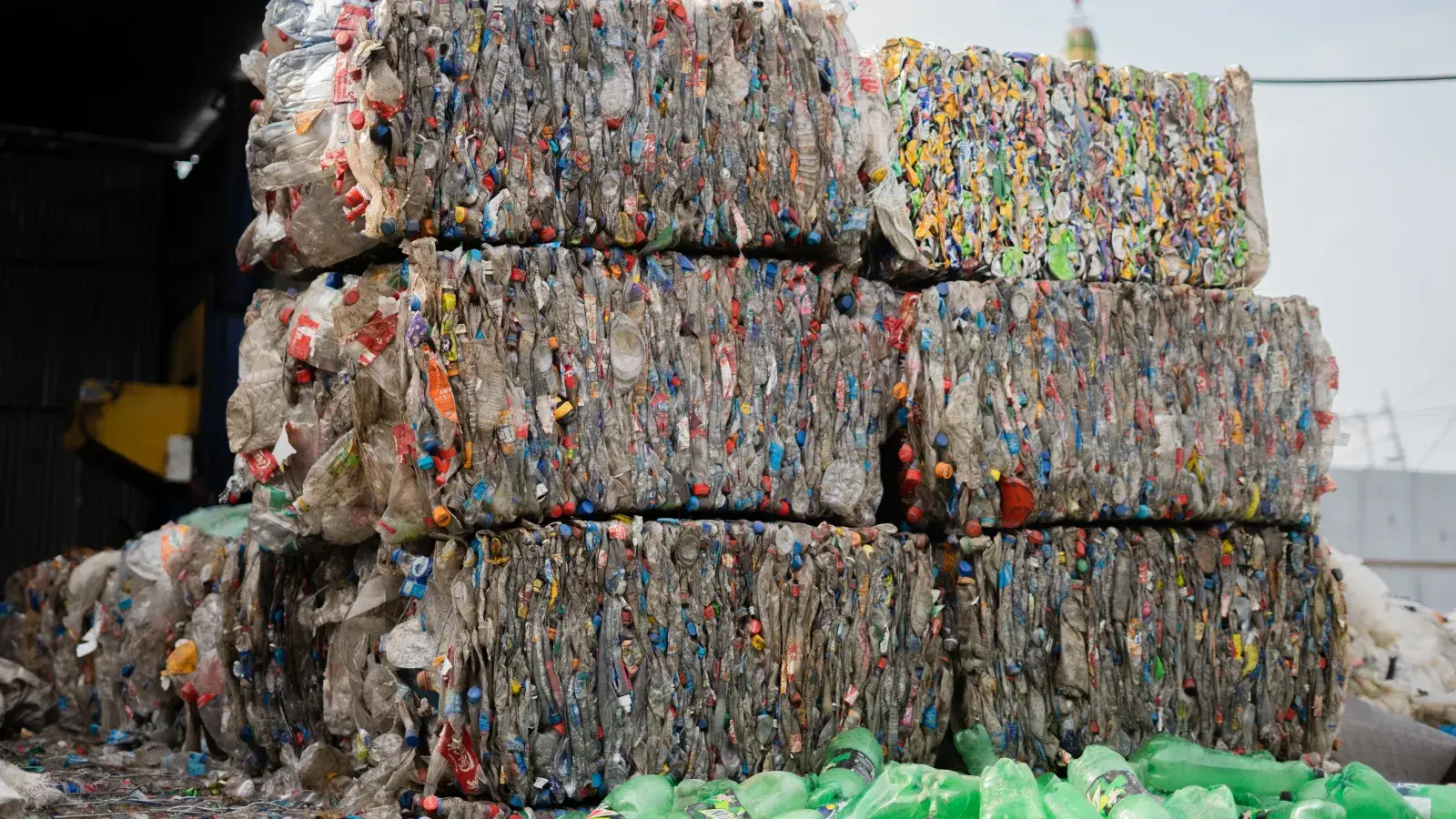
The technical case for better data becomes clearer against the size of the sector. ANTARA News reported in April 2026 that Indonesia has 749 plastic recycling companies with an installed capacity of around 3.16 million tonnes a year, and that utilisation of that capacity stands at 48 percent. The same reporting put the industry's contribution at about 20 percent of national plastic raw material supply, with an economic value in the region of 9.2 billion US dollars.
Read together, those figures describe an industry with room to grow inside assets it already owns. Roughly half of the installed capacity is idle, constrained largely by the supply and quality of feedstock reaching the gate. Every tonne of well sorted material that arrives at a processor is therefore a tonne that does not require new capital investment to absorb.
ADUPI now counts approximately 500 members across the value chain, from collection through processing to the manufacture of new raw materials and finished goods, according to Secretary General Edy Supriyanto, speaking during the same expo week. He set out three priorities for the association: turning discarded material into economically valuable resources, automating manual processes to speed up sorting and treatment, and developing the climate mitigation contribution of recycling. On the last point, he was explicit that regulatory support, credible measurement systems and multi stakeholder collaboration are all preconditions rather than optional extras.
The week that framed the announcement
The summit sat inside a larger gathering. The Indo Waste and Recycling 2026 Expo and Forum ran from 11 to 13 August 2026 at JIExpo Kemayoran, co located with the water, renewable energy, security, fire protection and smart city exhibitions, bringing together more than 700 companies from 23 countries with the support of over 30 ministries and institutions. The Director General of Regional Administration at the Ministry of Home Affairs, Safrizal ZA, opened the waste to energy forum during the same week.
Deputy Minister of Environment Diaz Hendropriyono, attending the event, acknowledged that the national recycling rate remains modest and stated that the ministry is ready to collaborate.
Our recycling rate is still relatively small, and we at the Ministry of Environment are ready to collaborate.
That is a candid and useful starting position. It names the gap and invites partners into it, which is precisely the posture that a measurement and verification project needs from the public side if its results are going to be used.
Sirkularium's view for government and public institutions
For ministries and regional governments, the significance of this agreement is that it addresses a bottleneck that no amount of additional hardware will clear on its own. Indonesia's 2029 commitment is expressed as a percentage of waste managed. A percentage is only as strong as the measurement behind it, and the recycling chain is the part of the system where measurement has historically been weakest, because so much of the value is recovered by informal collectors and small enterprises whose work leaves little documentation.
Three implications follow for policy and implementation.
First, on data governance. If a Digital MRV pilot is going to produce figures that ministries can use, the definitions, boundaries and verification steps should be aligned early with the national waste information system rather than reconciled later. A private sector traceability system and a public reporting system that disagree by design will create work for everyone.
Second, on financing. Verified recycling data is what turns a facility from a public expenditure line into an asset with a measurable output. Regional governments preparing waste processing investments, and the institutions financing them, gain a clearer basis for structuring performance conditions when the material recovered can be traced and confirmed.
Third, on inclusion. The chain being digitised starts at waste banks and collectors. A traceability framework designed with that first mile in mind, using simple capture methods that do not push cost onto the smallest actors, will both improve the data and strengthen the livelihoods that already do most of the recovery work.
What to watch next is the pilot itself. The proof of concept will show whether verified data can be produced at reasonable cost inside ordinary Indonesian recycling operations, and whether the resulting figures are accepted by the standards and registries that govern environmental claims. If that holds, the country gains a repeatable method for counting recovered material. That is a quiet result, and it is the kind that makes larger targets credible.
Sources
- Koran Jakarta, ADUPI, IDCTA and ESGIN build digital infrastructure for the recycling industry in support of the 2029 national waste target
- Republika ESG Now, recycling industry needs stronger data infrastructure to drive the circular economy
- InvestorTrust, Indonesia's plastic recycling industry encouraged to adopt a traceability system
- Rakyat Merdeka, ADUPI, IDCTA and ESGIN build digital infrastructure for the recycling industry
- Medcom, cross sector collaboration to strengthen the sustainable environment ecosystem at the Jakarta expo week
- Media Patriot, ADUPI promotes plastic recycling technology and carbon credit potential at the 2026 expo
- ANTARA News, recycling industry states its readiness to strengthen national plastic raw material supply