Toll road corridors become the first address for Indonesia's 100 gigawatt solar programme
By Sirkularium Editorial Team, 8 min read
The Ministry of Energy and Mineral Resources confirmed on 7 August that the opening phase of the national 100 gigawatt solar programme will be inaugurated along the Bali Mandara toll road, with the Sedyatmo corridor prepared next and a capacity study for the Trans Java toll road starting this year.
Indonesia's 100 gigawatt solar programme has spent most of 2026 as a target, a land inventory, and a financing question. On 7 August it acquired something more concrete: a first address.
A national target finally has a first address
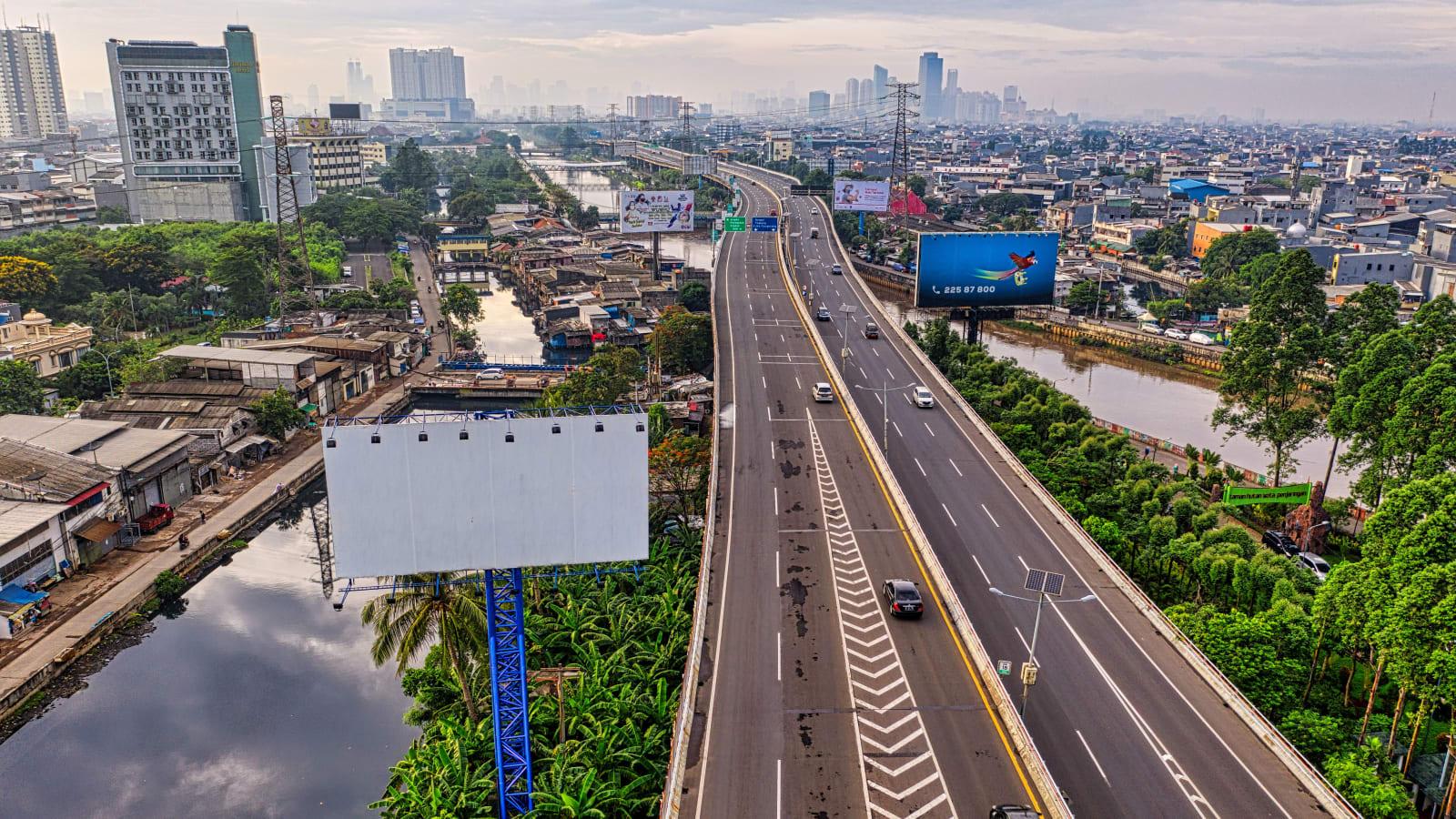
Tri Winarno, Acting Director General of Electricity at the Ministry of Energy and Mineral Resources, confirmed that the opening phase of the programme will be marked in Bali, and that the event will be an inauguration rather than a groundbreaking. The location is the Bali Mandara toll road, the elevated crossing over Benoa Bay, where panels are being installed along the edges of the carriageway rather than on newly acquired land.
Energy Minister Bahlil Lahadalia had signalled the venue three days earlier. Speaking on 4 August, he said he was seeking a date from President Prabowo Subianto for the ceremony, and that Bali was the likely choice. Deputy Minister Yuliot Tanjung confirmed on the same occasion that the programme has been written into the revised 2025 to 2034 electricity supply business plan, the RUPTL, which places it inside PLN's formal procurement and grid planning cycle rather than outside it.
The wording matters. An inauguration signals that hardware is in the ground and generating, not that a site has been cleared. For a programme of this scale, the difference between a symbolic first turf and a first operating asset is the difference between an ambition and a delivery record.
Speaking at the ministry on 6 August, Tri Winarno set out where the approach goes next.
For the development ahead, we asked for a study on roughly how much solar capacity could be obtained along the length of the Java toll road.
Why the road reserve is the cheapest land in the programme
The choice of toll corridors is not incidental. It answers the single hardest constraint the programme faces on Java, which is land.
In late May the ministry, working with the Ministry of Agrarian Affairs and Spatial Planning and the National Land Agency, identified roughly 24,000 hectares on Java as available to support the programme. That figure sounds substantial until it is set against the target. One hundred gigawatts is close to the entire installed generating capacity of the national system today. Eniya Listiani Dewi, Director General of New Energy, Renewable Energy and Energy Conservation, has described the task as building a second Indonesia-sized fleet on top of the existing one.
On 30 June the ministry set out how it intends to reach that scale without competing with agriculture, settlement, or forest. The strategy is a list of surfaces that already exist and are already disturbed: reservoir and dam surfaces for floating installations, in coordination with the Ministry of Public Works; post-mining sites; building rooftops; industrial estates, warehouses and commercial structures; and the reserve alongside toll roads.
Road reserve is the most administratively straightforward item on that list. It is under a single concession holder rather than thousands of individual titles. It is linear, which suits the way transmission and distribution assets are planned. It is already fenced, patrolled, and served by maintenance access. It carries no standing crop and no resident population. It is, in short, land whose acquisition cost has already been paid once, for a different purpose, by the state.
Siting generation on infrastructure that has already been built, financed, and secured is the lowest friction megawatt available to any government. It converts a sunk cost into a second revenue stream without asking a single household to move.
The Sedyatmo toll road, linking Jakarta to Soekarno-Hatta International Airport, is being prepared as the next corridor. The Trans Java toll road, which runs the length of the island from Merak to Probolinggo, is the subject of the capacity study the ministry commissioned in early August. Tri Winarno indicated that the study begins this year and that physical execution on the Java corridors would follow in 2027 at the earliest. His framing was plain: the year is already in August, so execution belongs to next year.
The numbers behind the 100 gigawatt push
The programme is sequenced rather than attempted in one movement. The first acceleration tranche is 17 gigawatts of solar, paired with battery energy storage that the ministry has put at roughly 33 gigawatts. The full 100 gigawatts is targeted for 2029. Part of the storage and generation package is also intended to displace diesel plants still running in the outer grids.
The financing estimate has moved as the design has firmed up. In June the ministry put the requirement at approximately USD 100 billion, equivalent to about Rp1,811 trillion at the exchange rate used at the time. A separate ministry briefing later in June cited a figure closer to Rp1,600 trillion spread over the coming decade. The two numbers are not reconciled in public reporting, and the gap is best read as the range within which the final capital plan will land rather than as a settled figure.
The economic case the government presents rests on substitution. The ministry projects that the programme would displace energy imports worth between USD 14.4 billion and USD 28.9 billion, and contribute up to USD 26.6 billion to gross domestic product. President Prabowo has tied the acceleration explicitly to energy security, citing strategic uncertainty arising from conflict in the Middle East as a reason to bring domestic generation forward.
A presidential regulation to accelerate implementation has been in preparation since mid-year, with coordination running across the energy, public works, land, and state-owned enterprise portfolios.
The engineering and coordination work still ahead
Corridor siting solves a land problem and creates an engineering one. Tri Winarno was direct about the main technical variable: wind. Panels mounted alongside an elevated highway, particularly one crossing open water as the Bali Mandara does, face loading conditions that a flat inland field does not. Mounting design, panel orientation, and spacing all have to be resolved against measured wind data rather than assumed from a standard rooftop specification. The study now underway for the Java corridor is expected to carry that assessment alongside the capacity estimate.
Two further items sit in the coordination column. The first is interconnection. Linear generation strung along a highway produces power in a shape the distribution network was not planned around, and the alignment of transmission and interconnection across the identified sites has been flagged by the deputy minister as part of the work programme. The second is the commercial arrangement with toll concession holders, whose asset is being asked to carry a second function it was not designed or tendered for.
None of this is unusual for infrastructure at this scale. It is the ordinary sequence of a programme moving from target to tender.
Sirkularium's read for government and public institutions
The significant decision here is not the capacity number. It is the siting doctrine.
By choosing already-committed surfaces first, the ministry has made land the servant of the programme rather than its ceiling. That is a resource-efficiency principle, and it is the same principle that governs good practice across the circular economy: extract more service from an asset already in place before commissioning a new one. A toll corridor generating power is an infrastructure asset earning a second yield. So is a reservoir surface, a post-mining site, or a factory roof.
For provincial and city governments, the practical implication is an inventory task that can begin immediately and does not wait on national tendering. Every jurisdiction holds a register of assets that meet the same test as a road reserve: single ownership, disturbed ground, existing security and access, no competing productive use. Public building roofs, terminal and port aprons, water utility land, closed landfill caps, and irrigation canal reserves all qualify. Identifying and pre-clearing those sites locally is the highest-value preparatory work available to a regional administration, because it converts a national target into a pipeline of ready parcels.
For PLN and its planning units, the corridor model rewards early interconnection design. Linear arrays are easy to build and awkward to connect, and the projects that move fastest will be those where the grid study was done alongside the capacity study rather than after it.
For financing institutions, the RUPTL entry is the signal worth tracking. A programme inside the electricity supply business plan is bankable in a way that a ministerial target is not.
What to watch next: the date the President sets for the Bali inauguration, the capacity figure the Java toll study returns, the text of the accelerating presidential regulation, and the commercial terms agreed with toll concession holders. Those four items will determine whether the corridor model scales beyond its first demonstration or remains a well-chosen showcase.
Projected economic effects of the 100 GW solar programme
Values in USD billion
Sources
- CNBC Indonesia, first phase of the 100 GW solar project to be inaugurated on the Bali toll road
- CNBC Indonesia, Indonesia to build solar along toll roads to reach 100 gigawatts
- ANTARA News, ministry studies solar development along the Trans Java toll road
- Republika, ministry assesses solar potential along the Trans Java toll road
- Liputan6, solar to be built on the Trans Java toll road with the study beginning this year
- Viva, ministry details the Trans Java toll road solar assessment
- Koran Jakarta, President to inaugurate phase one of the 100 GW solar project in Bali
- CNBC Indonesia, how the ministry plans to keep the 100 GW programme off productive land
- Ministry of Energy and Mineral Resources, deputy minister on accelerating the 100 GW solar programme